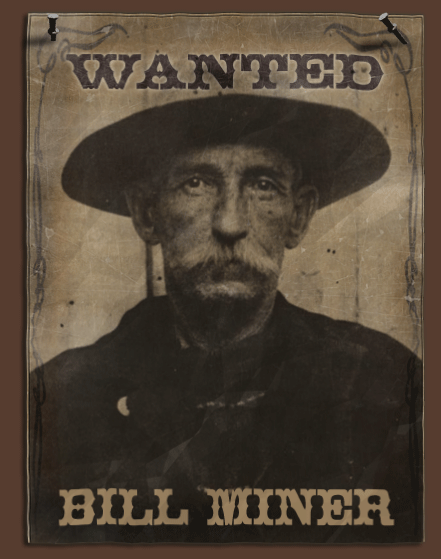
Never let it be said that we at the ol’ raincoaster blog stood by passively and watched our proud Canadian heritage slip into oblivion unmourned, unrecorded, unblogged. Now that the last of The Grey Fox‘s victims has been enveloped by the sweet embrace of the eternal, it is time to pause and reflect for a moment on that archetype of the Old West, the train robbery.
Consider this post to be the blogosphere equivalent of all those Schools of Chinese Culture, Roots Regained Circles, and those noble, innumerable, federally-funded oral history projects staffed by earnest future spinsters equipped with digital recorders and, always, the wrong shoes for the weather.
In true Canadian tradition, the art of the train robbery was introduced to Canada by an American, who brought it up from the States. Bill Miner, AKA The Grey Fox, AKA The Gentleman Bandit, was often taken for a Canadian by his own countrymen, perhaps on account of his legendary softspokenness and courtesy, despite possessing, all of his life, a telltale trace of his Kentucky birthplace in his accents.
Miner was no ordinary bandito when he arrived in British Columbia. Having been a stagecoach robber since the age of 16, he was as famous throughout North America as the man who first put crime and syntax together in the felicitous and elegantly simple catchphrase, “Hands up.”
But I digress…
Put simply, there are several traditional methods of holding up a train.
First (and this is common to all methods) select your train. It is advisable to select one carrying a great deal of money and moving slowly through rough, deserted territory. Steam trains taking safes full of gold dust south from the Cariboo mines are ideal. As you can see, here we tawdry moderns face our first insurmountable obstacle: the Cariboo gold fields are relatively played out, and you could probably get more money sticking up a bingo hall on Welfare Wednesday. Sic transit glamour mundi.
Now that you have selected your train, the methods diverge:
- Method A is simply to put something big on the tracks, in hopes the driver will simply become so confused he’ll stop and sit there, perhaps wondering how that large, freshly-cut log got there, or cursing the obscure illness that struck that moose dead right across the tracks. At this point, the robbers pop out of the woods, flourish a weapon, and either take the loot or, for the more discriminating robber, proceed to Method D’s advanced steps. This method, however, is easily thwarted by train drivers who simply back up instead of sitting still. A variation of this method was used in the Great Train Robbery as late as 1963. I guess those Brits don’t watch a lot of Westerns.
- Method B is simply to put something on the tracks that will derail the train, thereafter following procedures as outlined in Method A, only maybe sometimes horizontally. This has the following disadvantages: it is hella noisy, drawing unwanted attention even on the most desolate of mountainsides; it kills a lot of people, and this is always a disadvantage when you factor potential jail sentences vs potential lynchings into the ROI; and the entire thing may catch fire, preventing you from making off with the gold and rendering the entire episode needlessly gruesome and unprofitable.
- Method C, favoured by film directors who’ve never left Los Angeles County, is to gallop up alongside the train and climb aboard, flourish your weapon in the engineer’s startled face, and take the loot, although not before stealing the heart of a winsome blonde passenger.
- Method D, and this is the method favoured by the Grey Fox himself, is to wait till the train makes an scheduled stop at a mail depot or some other unpopulated spot, sneak aboard, climb over the tender (which carries the wood or coal for the engine) flourish your weapon in the engineer’s face, and proceed to the advanced steps.
The advanced steps are as follows:
- You want the money. You don’t want the passengers; they’re a lot of hassle, just ask any porter. So you stop the train and uncouple the passenger cars, taking great care to keep the engine attached to the express car, the one with all the gold in it (some robbers were not so careful about this and even The Grey Fox’s team screwed it up from time to time). You then proceed forward with the train; this has the advantage that, if another train is following up the track, it’ll hit the passenger cars and that will slow down pursuit as well as buffer the cars that the gang is in. You convince the guard, through effective flourishment of your weapons, to open the safes. If he fails to open the safes, you proceed to use dynamite to open them. You then stop the train at a prearranged point, where your getaway man is waiting with the horses, bid the beleaguered train crew good evening, and ride off into the night with gold and securities worth a king’s ransom.
Any questions, class?
 ::
::  ::
::  ::
::  ::
::  ::
::  ::
::  ::
::  ::
::  ::
::  ::
:: 


 raincoaster