A Victorian Skating Party

Christmas Ghost Stories: The Real and the Counterfeit, by Mrs Alfred Baldwin

We’re on a Christmas country house themed roll, kittens, and I see no reason to stop rolling with it as long as the pickin’s are this good. Tonight’s Christmas ghost story comes from the ancient and revered tradition of the pooh-pooher or, more technically known as, “the skeptic.”

The Skeptic doesn’t believe in ghosts. But he’s a regular character in ghost stories, one of the mainstays in fact. Sometimes he lives long enough to get his comeupppance and sometimes he doesn’t, but you know going into it that the deck he refuses to acknowledge is stacked against him.

The Real and the Counterfeit is a story with great heart, and with romance, and strong characters, and pranks and hijinks and japes and ruses and all those other delightfully antiquated words and deeds (nowadays we’d just call it trolling and block them on Facebook) so I hope that you will enjoy tonight’s offering.


The Real and the Counterfeit
by Mrs Alfred Baldwin

A Victorian Skating Party

A Victorian Skating Party

Will Musgrave determined that he would neither keep Christmas alone, nor spend it again with his parents and sisters in the south of France. The Musgrave family annually migrated southward from their home in Northumberland, and Will as regularly followed them to spend a month with them in the Riviera, till he had almost forgotten what Christmas was like in England. He rebelled at having to leave the country at a time when, if the weather was mild, he should be hunting, or if it was severe, skating, and he had no real or imaginary need to winter in the south. His chest was of iron and his lungs of brass. A raking east wind that drove his parents into their thickest furs, and taught them the number of their teeth by enabling them to count a separate and well defined ache for each, only brought a deeper colour into the cheek, and a brighter light into the eye of the weather-proof youth. Decidedly he would not go to Cannes, though it was no use annoying his father and mother, and disappointing his sisters, by telling them beforehand of his determination.

Will knew very well how to write a letter to his mother in which his defection should appear as an event brought about by the over-mastering power of circumstances, to which the sons of Adam must submit. No doubt that a prospect of hunting or skating, as the fates might decree, influenced his decision. But he had also long promised himself the pleasure of a visit from two of his college friends, Hugh Armitage and Horace Lawley, and he asked that they might spend a fortnight with him at Stonecroft, as a little relaxation had been positively ordered for him by his tutor.

‘Bless him,’ said his mother fondly, when she had read his letter, ‘I will write to the dear boy and tell him how pleased I am with his firmness and determination.’ But Mr Musgrave muttered inarticulate sounds as he listened to his wife, expressive of incredulity rather than acquiescence, and when he spoke it was to say, ‘Devil of a row three young fellows will kick up alone at Stonecroft! We shall find the stables full of broken-kneed horses when we go home again.’

Will Musgrave spent Christmas day with the Armitages at their lace near Ripon. And the following night they gave a dance at which he enjoyed himself as only a very young man can do, who has not yet had his fill of dancing, and who would like nothing better than to waltz through life with his arm round his pretty partner’s waist. The following day, Musgrave and Armitage left for Stonecroft, picking up Lawley on the way, and arriving at their destination late in the evening, in the highest spirits and with the keenest appetites. Stonecroft was a delightful haven of refuge at the end of a long journey across country in bitter weather, when the east wind was driving the light dry snow into every nook and cranny. The wide, hospitable front door opened into an oak-panelled hall with a great open fire burning cheerily, and lighted by lamps from overhead that effectually dispelled all gloomy shadows. As soon as Musgrave had entered the house he seized his friends, and before they had time to shake the snow from their coats, kissed them both under the mistletoe bough and set the servants tittering in the background.

‘You’re miserable substitutes for your betters,’ he said, laughing and pushing them from him, ‘but it’s awfully unlucky not to use the mistletoe. Barker, I hope supper’s ready, and that it is something very hot and plenty of it, for we’ve travelled on empty stomachs and brought them with us,’ and he led his guests upstairs to their rooms.

‘What a jolly gallery!’ said Lawley enthusiastically as they entered a long wide corridor, with many doors and several windows in it, and hung with pictures and trophies of arms.

‘Yes, it’s our one distinguishing feature at Stonecroft,’ said Musgrave. ‘It runs the whole length of the house, from the modern end of it to the back, which is very old, and built on the foundations of a Cistercian monastery which once stood on this spot. The gallery’s wide enough to drive a carriage and pair down it, and it’s the main thoroughfare of the house. My mother takes a constitutional here in bad weather, as though it were the open air, and does it with her bonnet on to aid the delusion.’

Armitage’s attention was attracted by the pictures on the walls, and especially by the life-size portrait of a young man in a blue coat, with powdered hair, sitting under a tree with a staghound lying at his feet.

‘An ancestor of yours?’ he said, pointing at the picture.

‘Oh, they’re all one’s ancestors, and a motley crew they are, I must say for them. It may amuse you and Lawley to find from which of them I derive my good looks. That pretty youth whom you seem to admire is my great-great-grandfather. He died at twenty-two, a preposterous age for an ancestor. But come along Armitage, you’ll have plenty of time to do justice to the pictures by daylight, and I want to show you your rooms. I see everything is arranged comfortably, we are close together. Our pleasantest rooms are on the gallery, and here we are nearly at the end of it. Your rooms are opposite to mine, and open into Lawley’s in case you should be nervous in the night and feel lonely so far from home, my dear children.’

And Musgrave bade his friends make haste, and hurried away whistling cheerfully to his own room.

The following morning the friends rose to a white world. Six inches of fine snow, dry as salt, lay everywhere, the sky overhead a leaden lid, and all the signs of a deep fall yet to come.

‘Cheerful this, very,’ said Lawley, as he stood with his hands in his pockets, looking out of the window after breakfast. ‘The snow will have spoilt the ice for skating.’

‘But it won’t prevent wild duck shooting,’ said Armitage, ‘and I say, Musgrave, we’ll rig up a toboggan out there. I see a slope that might have been made on purpose for it. If we get some tobogganing, it may snow day and night for all I care, we shall be masters of the situation any way.’

‘Well thought of, Armitage,’ said Musgrave, jumping at the idea.

‘Yes, but you need two slopes and a little valley between for real good tobogganing,’ objected Lawley, ‘otherwise you only rush down the hillock like you do from the Mount Church to Funchal, and then have to retrace your steps as you do there, carrying your car on your back. Which lessens the fun considerably.’

‘Well, we can only work with the material at hand,’ said Armitage; ‘let’s go and see if we can’t find a better place for our toboggan, and something that will do for a car to slide in.’

‘That’s easily found – empty wine cases are the thing, and stout sticks to steer with,’ and away rushed the young men into the open air, followed by half a dozen dogs barking joyfully.

‘By Jove! if the snow keeps firm, we’ll put runners on strong chairs and walk over to see the Harradines at Garthside, and ask the girls to come out sledging, and we’ll push them,’ shouted Musgrave to Lawley and Armitage, who had outrun him in the vain attempt to keep up with a deer-hound that headed the party. After a long and careful search they found a piece of land exactly suited to their purpose, and it would have amused their friends to see how hard the young men worked under the beguiling name of pleasure. For four hours they worked like navvies making a toboggan slide. They shovelled away the snow, then with pickaxe and spade, levelled the ground, so that when a carpet of fresh snow was spread over it, their improvised car would run down a steep incline and be carried by the impetus up another, till it came to a standstill in a snow drift.

‘If we can only get this bit of engineering done today,’ said Lawley, chucking a spadeful of earth aside as he spoke, ‘the slide will be in perfect order for tomorrow.’

‘Yes, and when once it’s done, it’s done for ever,’ said Armitage, working away cheerfully with his pick where the ground was frozen hard and full of stones, and cleverly keeping his balance on the slope as he did so. ‘Good work lasts no end of time, and posterity will bless us for leaving them this magnificent slide.’

‘Posterity may, my dear fellow, but hardly our progenitors if my father should happen to slip down it,’ said Musgrave.

When their task was finished, and the friends were transformed in appearance from navvies into gentlemen, they set out through thick falling snow to walk to Garthside to call on their neighbours the Harradines. They had earned their pleasant tea and lively talk, their blood was still aglow from their exhilarating work, and their spirits at the highest point. They did not return to Stonecroft till they had compelled the girls to name a time when they would come with their brothers and be launched down the scientifically prepared slide, in wine cases well padded with cushions for the occasion.

Late that night the young men sat smoking and chatting together in the library. They had played billiards till they were tired, and Lawley had sung sentimental songs, accompanying himself on the banjo, till even he was weary, to say nothing of what his listeners might be. Armitage sat leaning his light curly head back in the chair, gently puffing out a cloud of tobacco smoke. And he was the first to break the silence that had fallen on the little company.

‘Musgrave,’ he said suddenly, ‘an old house is not complete unless it is haunted. You ought to have a ghost of your own at Stonecroft.’

Musgrave threw down the yellow-backed novel he had just picked up, and became all attention.

‘So we have, my dear fellow. Only it has not been seen by any of us since my grandfather’s time. It is the desire of my life to become personally acquainted with our family ghost.’

Armitage laughed. But Lawley said, ‘You would not say that if you really believed in ghosts.’

‘I believe in them most devoutly, but I naturally wish to have my faith confirmed by sight. You believe in them too, I can see.’

‘Then you see what does not exist, and so far you are in a fair way to see ghosts. No, my state of mind is this,’ continued Lawley, ‘I neither believe, nor entirely disbelieve in ghosts. I am open to conviction on the subject. Many men of sound judgement believe in them. I merely regard the case of the bogies as not proven. They may or may not exist, but till their existence is plainly demonstrated, I decline to add such an uncomfortable article to my creed as belief in bogies.’

Musgrave did not reply, but Armitage laughed a strident laugh.

‘I’m one against two, I’m in an overwhelming minority,’ he said. ‘Musgrave frankly confesses his belief in ghosts, and you are neutral, neither believing nor disbelieving, but open to conviction. Now I’m a complete unbeliever in the supernatural, root and branch. People’s nerves no doubt play them queer tricks, and will continue to do so to the end of the chapter, and if I were so fortunate as to see Musgrave’s family ghost tonight, I should no more believe in it than I do now. By the way, Musgrave, is the ghost a lady or a gentleman?’ he asked flippantly.

‘I don’t think you deserve to be told.’

‘Don’t you know that a ghost is neither he nor she?’ said Lawley, ‘Like a corpse, it is always it.’

‘That is a piece of very definite information from a man who neither believes nor disbelieves in ghosts. How do you come by it, Lawley?’ asked Armitage.

‘Mayn’t a man be well informed on a subject although he suspends his judgement about it? I think I have the only logical mind among us. Musgrave believes in ghosts though he has never seen one, you don’t believe in them, and say that you would not be convinced if you saw one, which is not wise, it seems to me.’

‘It is not necessary to my peace of mind to have a definite opinion on the subject. After all, it is only a matter of patience, for if ghosts really exist we shall each be one in the course of time, and then, if we’ve nothing better to do, and are allowed to play such unworthy pranks, we may appear again on the scene, and impartially scare our credulous and incredulous surviving friends.’

‘Then I shall try to be beforehand with you, Lawley, and turn bogie first; it would suit me better to scare than to be scared. But, Musgrave, do tell me about your family ghost; I’m really interested in it, and I’m quite respectful now.’

‘Well, mind you are, and I shall have no objection to tell you what I know about it, which is briefly this: Stonecroft, as I told you, is built on the site of an old Cistercian Monastery destroyed at the time of the Reformation. The back part of the house rests on the old foundations, and its walls are built with the stones that were once part and parcel of the monastery. The ghost that has been seen by members of the Musgrave family for three centuries past, is that of a Cistercian monk, dressed in the white habit of his order. Who he was, or why he has haunted the scenes of his earthly life so long, there is no tradition to enlighten us. The ghost has usually been seen once or twice in each generation. But as I said, it has not visited us since my grandfather’s time, so, like a comet, it should be due again presently.’

‘How you must regret that was before your time,’ said Armitage.

‘Of course I do, but I don’t despair of seeing it yet. At least I know where to look for it. It has always made its appearance in the gallery, and I have my bedroom close to the spot where it was last seen, in the hope that if I open my door suddenly some moonlight night I may find the monk standing there.’

‘Standing where?’ asked the incredulous Armitage.

‘In the gallery, to be sure, midway between your two doors and mine, That is where my grandfather last saw it. He was waked in the dead of night by the sound of a heavy door shutting. He ran into the gallery where the noise came from, and, standing opposite the door of the room I occupy, was the white figure of the Cistercian monk. As he looked, it glided the length of the gallery and melted like mist into the wall. The spot where he disappeared is on the old foundations of the monastery, so that he was evidently returning to his own quarters.’

‘And your grandfather believed that he saw a ghost?’ asked Armitage disdainfully.

‘Could he doubt the evidence of his senses? He saw the thing as clearly as we see each other now, and it disappeared like a thin vapour against the wall.’

‘My dear fellow, don’t you think that it sounds more like an anecdote of your grandmother than of your grandfather?’ remarked Armitage. He did not intend to be rude, though he succeeded in being so, as he was instantly aware by the expression of cold reserve that came over Musgrave’s frank face.

‘Forgive me, but I never can take a ghost story seriously,’ he said. ‘But this much I will concede – they may have existed long ago in what were literally the dark ages, when rushlights and spluttering dip candles could not keep the shadows at bay. But in this latter part of the nineteenth century, when gas and the electric light have turned night into day, you have destroyed the very conditions that produce the ghost – or rather the belief in it, which is the same thing. Darkness has always been bad for human nerves. I can’t explain why, but so it is. My mother was in advance of the age on the subject, and always insisted on having a good light burning in the night nursery, so that when as a child I woke from a bad dream I was never frightened by the darkness. And in consequence I have grown up a complete unbeliever in ghosts, spectres, wraiths, apparitions, doppelgänger, and the whole bogie crew of them,’ and Armitage looked round calmly and complacently.

‘Perhaps I might have felt as you do if I had not begun life with the knowledge that our house was haunted,’ replied Musgrave with visible pride in the ancestral ghost. ‘I only wish that I could convince you of the existence of the supernatural from my own personal experience. I always feel it to be the weak point in a ghost story, that it is never told in the first person. It is a friend, or a friend of one’s friend, who was the lucky man, and actually saw the ghosts.’ And Armitage registered registered a vow to himself, that within a week from that time Musgrave should see his family ghost with his own eyes, and ever after be able to speak with his enemy in the gate.

Several ingenious schemes occurred to his inventive mind for producing the desired apparition. But he had to keep them burning in his breast. Lawley was the last man to aid and abet him in playing a practical joke on their host, and he feared he should have to work without an ally. And hough he would have enjoyed his help and sympathy, it struck him that it would be a double triumph achieved, if both his friends should see the Cistercian monk. Musgrave already believed in ghosts, and was prepared to meet one more than half-way, and Lawley, though he pretended to a judicial and impartial mind concerning them, was not unwilling to be convinced of their existence, if it could be visibly demonstrated to him.

Armitage became more cheerful than usual as circumstances favoured his impious plot. The weather was propitious for the attempt he meditated, as the moon rose late and was approaching the full. On consulting the almanac he saw with delight that three nights hence she would rise at 2 a.m., and an hour later the end of the gallery nearest Musgrave’s room would be flooded with her light. Though Armitage could not have an accomplice under the roof, he needed one within reach, who could use needle and thread, to run up a specious imitation of the white robe and hood of a Cistercian monk. And the next day, when they went to the Harradines to take the girls out in their improvised sledges, it fell to his lot to take charge of the youngest Miss Harradine. As he pushed the low chair on runners over the hard snow, nothing was easier than to bend forward and whisper to Kate, ‘I am going to take you as fast as I can, so that no-one can hear what we are saying. I want you to be very kind, and help me to play a perfectly harmless practical joke on Musgrave. Will you promise to keep my secret for a couple of days, when we shall all enjoy a laugh over it together?’

‘Oh yes, I’ll help you with pleasure, but make haste and tell me what your practical joke is to be.’

‘I want to play ancestral ghost to Musgrave, and make him believe that he has seen the Cistercian monk in his white robe and cowl, that was last seen by his respected credulous grandpapa.’

‘What a good idea! I know he is always longing to see the ghost, and takes it as a personal affront that it has never appeared to him. But might it not startle him more than you intend?’ and Kate turned her glowing face towards him, and Armitage involuntarily stopped the little sledge, ‘for it is one thing to wish to see a ghost, you know, and quite another to think that you see it.’

‘Oh, you need not fear for Musgrave! We shall be conferring a positive favour on him, in helping hi to see what he’s so wishful to see. I’m arranging it so that Lawley shall have the benefit of the show as well, and see the ghost at the same time with him. And if two strong men are not a match for one bogie, leave alone a home-made counterfeit one, it’s a pity.’

‘Well, if you think it’s a safe trick to play, no doubt you are right. But how can I help you? With the monk’s habit, I suppose?’

‘Exactly. I shall be so grateful to you if you will run up some sort of garment, that will look passably like a white Cistercian habit to a couple of men, who I don’t think will be in a critical frame of mind during the short time they are allowed to see it. I really wouldn’t trouble you if I were anything of a sempster (is that the masculine of sempstress?) myself, but I’m not. A thimble bothers me very much, and at college, when I have to sew on a button, I push the needle through on one side with a threepenny bit, and pull it out on the other with my teeth, and it’s a laborious process.’

Kate laughed merrily. ‘Oh, I can easily make something or other out of a white dressing-gown, fit for a ghost to wear, and fasten a hood to it.’

Armitage then told her the details of his deeply-laid scheme, how he would go to his room when Musgrave and Lawley went to theirs on the eventful night, and sit up till he was sure that they were fast asleep. Then when the moon had risen, and if her light was obscured by clouds he would be obliged to postpone the entertainment till he could be sure of her aid, he would dress himself as the ghostly monk, put out the candles, softly open the door, and look into the gallery to see that all was ready. ‘Then I shall slam the door with an awful bang, for that was the noise that heralded the ghost’s last appearance, and it will wake Musgrave and Lawley, and bring them both out of their rooms like a shot. Lawley’s door is next to mine, and Musgrave’s opposite, so that each will command a magnificent view of the monk at the same instant, and they can compare notes afterwards at their leisure.’

‘But what shall you do if they find you out at once?’

‘Oh, they won’t do that! The cowl will be drawn over my face, and I shall stand with my back to the moonlight. My private belief is, that in spite of Musgrave’s yearnings after a ghost, he won’t like it when he thinks he sees it. Nor will Lawley, and I expect they’ll dart back into their rooms and lock themselves in as soon as they catch sight of the monk. That would give me time to whip back into my room, turn the key, strip off my finery, hide it, and be roused with difficulty from a deep sleep when they come knocking at my door to tell me what a horrible thing has happened. And one more ghost story will be added to those already in circulation,’ and Armitage laughed aloud in anticipation of the fun.

‘It is to be hoped that everything will happen just as you have planned it, and then we shall all be pleased. And now will you turn the sledge round and let us join the others, we have done conspiring for the present. If we are seen talking so exclusively to each other, they will suspect that we are brewing some mischief together. Oh, how cold the wind is! I like to hear it whistle in my hair!’ said Kate as Armitage deftly swung the little sledge round and drove it quickly before him, facing the keen north wind, as she buried her chin in her warm furs.

Armitage found an opportunity to arrange with Kate, that he would meet her half-way between Stonecroft and her home, on the afternoon of the next day but one, when she would give him a parcel containing the monk’s habit. The Harradines and their house party were coming on Thursday afternoon to try the toboggan slide at Stonecroft. But Kate and Armitage were willing to sacrifice their pleasure to the business they had in hand.

There was no other way but for the conspirators to give their friends the slip for a couple of hours, when the important parcel would be safely given to Armitage, secretly conveyed by him to his own room, and locked up till he should want it in the small hours of the morning.

When the young people arrived at Stonecroft Miss Harradine apologised for her younger sister’s absence – occasioned, she said, by a severe headache. Armitage’s heart beat rapidly when he heard the excuse, and he thought how convenient it was for the inscrutable sex to be able to turn on a headache at will, as one turns on hot or cold water from a tap.

After luncheon, as there were more gentlemen than ladies, and Armitage’s services were not necessary at the toboggan slide, he elected to take the dogs for a walk, and set off in the gayest spirits to keep his appointment with Kate. Much as he enjoyed maturing his ghost plot, he enjoyed still more the confidential talks with Kate that had sprung out of it, and he was sorry that this was to be the last of them. But the moon in heaven could not be stayed for the performance of his little comedy, and her light was necessary to its due performance. The ghost must be seen at three o’clock next morning, at the time and place arranged, when the proper illumination for its display would be forthcoming.

As Armitage walked swiftly over the hard snow, he caught sight of Kate at a distance. She waved her hand gaily and pointed smiling to the rather large parcel she was carrying. The red glow of the winter sun shone full upon her, bringing out the warm tints in her chestnut hair, and filling her brown eyes with soft lustre, and Armitage looked at her with undisguised admiration.

‘It’s awfully good of you to help me so kindly,’ he said as he took the parcel from her, ‘and I shall come round tomorrow to tell you the result of our practical joke. But how is the headache?’ he asked smiling, ‘you look so unlike aches or pains of any kind, I was forgetting to enquire about it.’

‘Thank you, it is better. It was not altogether a made-up headache, though it happened opportunely. I was awake in the night, not in the least repenting that I was helping you, of course, but wishing it was all well over. One has heard of this kind of trick sometimes proving too successful, of people being frightened out of their wits by a make-believe ghost, and I should never forgive myself if Mr Musgrave or Mr Lawley were seriously alarmed.’

‘Really, Miss Harradine, I don’t think that you need give yourself a moment’s anxiety about the nerves of a couple of burley young men. If you are afraid for anyone, let it be for me. If they find me out, they will fall upon me and rend me limb from limb on the spot. I can assure you I am the only one for whom there is anything to fear,’ and the transient gravity passed like a cloud from Kate’s bright face. And she admitted that it was rather absurd to be uneasy about two stalwart young men compounded more of muscle than of nerves. And they parted, Kate hastening home as the early twilight fell, and Armitage, after watching her out of sight, retracing his steps with the precious parcel under his arm.

He entered the house unobserved, and reaching the gallery by a back staircase, felt his way in the dark to his room. He deposited his treasure in the wardrobe, locked it up, and attracted by the sound of laughter, ran downstairs to the drawing-room. Will Musgrave and his friends, after a couple of hours of glowing exercise, had been driven indoors by the darkness, nothing loath to partake of tea and hot cakes, while they talked and laughed over the adventures of the afternoon.

‘Wherever have you been, old fellow?’ said Musgrave as Armitage entered the room. ‘I believe you’ve a private toboggan of your own somewhere that you keep quiet. If only the moon rose at a decent time, instead of some unearthly hour in the night, when it’s not of the slightest use to anyone, we would have gone out looking for you.’

‘You wouldn’t have had far to seek, you’d have met me on the turnpike road.’

‘But why this subdued and chastened taste? Imagine preferring a constitutional on the high road when you might have been tobogganing with us! My poor friend, I’m afraid you are not feeling well!’ said Musgrave with an affectation of sympathy that ended in boyish laughter and a wrestling match between the two young men, in the course of which Lawley more than once saved the tea table from being violently overthrown.

Presently, when the cakes and toast had disappeared before the youthful appetites, lanterns were lighted, and Musgrave and his friends, and the Harradine brothers, set out as a bodyguard to take the young ladies home. Armitage was in riotous spirits, and finding that Musgrave and Lawley had appropriated the two prettiest girls in the company, waltzed untrammelled along the road before them lantern in hand, like a very will-o’-the-wisp.

The young people did not part till they had planned fresh pleasures for the morrow, and Musgrave, Lawley, and Armitage returned to Stonecroft to dinner, making the thin air ring to the jovial songs with which they beguiled the homeward journey.

Late in the evening, when the young men were sitting in the library, Musgrave suddenly exclaimed, as he reached down a book from an upper shelf, ‘Hallo! I’ve come on my grandfather’s diary! Here’s his own account of how he saw the white monk in the gallery. Lawley, you may read it if you like, but it shan’t be wasted on an unbeliever like Armitage. By Jove! what an odd coincidence! It’s forty years this very night, the thirtieth of December, since he saw the ghost,’ and he handed the book to Lawley, who read Mr Musgrave’s narrative with close attention.

‘Is it a case of “almost thou persuadest me”?’ asked Armitage, looking at his intent and knitted brow.

‘I hardly know what to think. Nothing positive either way at any rate.’ And he dropped the subject, for he saw Musgrave did not wish to discuss the family ghost in Armitage’s unsympathetic presence.

They retired late, and the hour that Armitage had so gleefully anticipated drew near. ‘Good night both of you,’ said Musgrave as he entered his room, ‘I shall be asleep in five minutes. All this exercise in the open air makes a man absurdly sleep at night,’ and the young men closed their doors, and silence settled down upon Stonecoft Hall. Armitage and Lawley’s rooms were next to each other, and in less than a quarter of an hour Lawley shouted a cheery goodnight, which was loudly returned by his friend. Then Armitage felt somewhat mean and stealthy. Musgrave and Lawley were both confidently asleep, while he sat up alert and vigilant maturing a mischievous plot that had for its object the awakening and scaring of both the innocent sleepers. He dared not smoke to pass the tedious time, lest the tell-tale fumes should penetrate into the next room through the keyhole, and inform Lawley if he woke for an instant that his friend was awake too, and behaving as though it were high noon.

Armitage spread the monk’s white habit on the bed, and smiled as he touched it to think that Kate’s pretty fingers had been so recently at work upon it. He need not put it on for a couple of hours yet, and to occupy the time he sat down to write. He would have liked to take a nap. But he knew that if he once yielded to sleep, nothing would wake him till he was called at eight o’clock in the morning. As he bent over his desk the big clock in the hall struck one, so suddenly and sharply it was like a blow on the head, and he started violently. ‘What a swinish sleep Lawley must be in that he can’t hear a noise like that!’ he thought, as snoring became audible from the next room. Then he drew the candles nearer to him, and settled once more to his writing, and a pile of letters testified to his industry, when again the clock struck. But this time he expected it, and it did not startle him, only the cold made him shiver. ‘If I hadn’t made up my mind to go through with this confounded piece folly, I’d go to bed now,’ he thought, ‘but I can’t break faith with Kate. She’s made the robe and I’ve got to wear it, worse luck,’ and with a great yawn he threw down his pen, and rose to look out of the window. It was a clear frosty night. At the edge of the dark sky, sprinkled with stars, a faint band of cold light heralded the rising moon. How different from the grey light of dawn, that ushers in the cheerful day, is the solemn rising of the moon in the depth of a winter night. Her light is not to rouse a sleeping world and lead men forth to their labour, it falls on the closed eyes of the weary, and silvers the graves of those whose rest shall be broken no more. Armitage was not easily impressed by the sombre aspect of nature, though he was quick to feel her gay and cheerful influence, but he would be glad when the farce was over, and he no longer obliged to watch the rise and spread of the pale light. solemn as the dawn of the last day.

He turned from the window, and proceeded to make himself into the best imitation of a Cistercian monk that he could contrive. He slipt the white habit over all his clothing, that he might seem of portly size, and marked dark circles round his eyes, and thickly powdered his face a ghostly white.

Armitage silently laughed at his reflection in the glass, and wished that Kate could see him now. Then he softly opened the door and looked into the gallery. The moonlight was shimmering duskily on the end window to the right of his door and Lawley’s. It would soon be where he wanted it, and neither too light nor too dark for the success of his plan. He stepped silently back again to wait, and a feeling as much akin to nervousness as he had ever known came over him. His heart beat rapidly, he started like a timid girl when the silence was suddenly broken by the hooting of an owl. He no longer cared to look at himself in the glass. He had taken fright at the mortal pallor of his powdered face. ‘Hang it all! I wish Lawley hadn’t left off snoring. It was quite companionable to hear him.’ And again he looked into the gallery, and now the moon shed her cold beams where he intended to stand. He put out the light and opened the door wide, and stepping into the gallery threw it to with an echoing slam that only caused Musgrave and Lawley to start and turn on their pillows. Armitage stood dressed as the ghostly monk of Stonecroft, in the pale moonlight in the middle of the gallery, waiting for the door on either side to fly open and reveal the terrified faces of his friends.

He had time to curse the ill-luck that made them sleep so heavily that night of all nights, and to fear lest the servants had heard the noise their master had been deaf to, and would come hurrying to the spot and spoil the sport. But no-one came, and as Armitage stood, the objects in the long gallery became clearer every moment, as his sight accommodated itself to the dim light. ‘I never noticed before that there was a mirror at the end of the gallery! I should not have believed the moonlight was bright enough for me to see my own reflection so far off, only white stands out so in the dark. But is it my own reflection? Confound it all, the thing’s moving and I’m standing still! I know what it is! It’s Musgrave dressed up to try to give me a fright, and Lawley’s helping him. They’ve forestalled me, that’s why they didn’t come out of their rooms when I made a noise fit to wake the dead. Odd we’re both playing the same practical joke at the same moment! Come on, my counterfeit bogie, and we’ll see which of us turns white-livered first!’

But to Armitage’s surprise, that rapidly became terror, the white figure that he believed to be Musgrave disguised, and like himself playing ghost, advanced towards him, slowly gliding over the floor which its feet did not touch. Armitage’s courage was high, and he determined to hold his ground against the something ingeniously contrived by Musgrave and Lawley to terrify him into belief in the supernatural. But a feeling was creeping over the strong young man that he had never known before. He opened his dry mouth as the thing floated towards him, and there issued a hoarse inarticulate cry, that woke Musgrave and Lawley and brought them to their doors in a moment, not knowing by what strange fright they had been startled out of their sleep. Do not think them cowards that they shrank back appalled from the ghostly forms the moonlight revealed to them in the gallery. But as Armitage vehemently repelled the horror that drifted nearer and nearer to him, the cowl slipped from his head, and his friends recognised his white face, distorted by fear and, springing towards him as he staggered, supported him in their arms. The Cistercian monk passed them like a white mist that sank into the wall, and Musgrave and Lawley were alone with the dead body of their friend, whose masquerading dress had become his shroud.
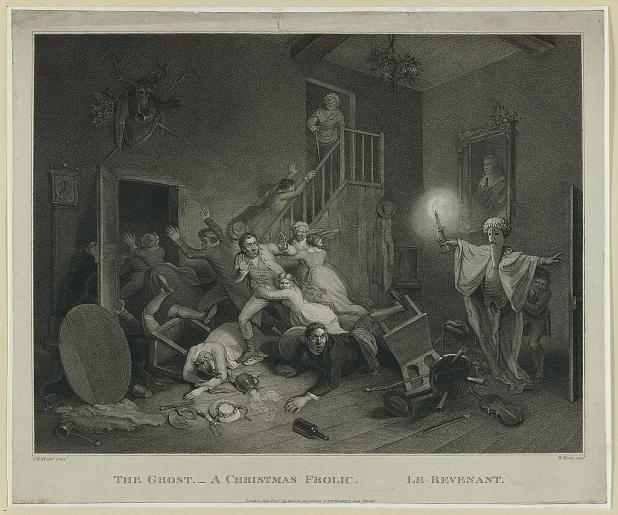
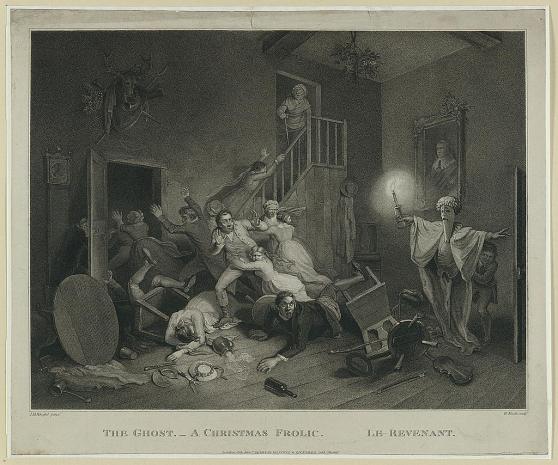
A Christmas Ghost

Christmas Ghost Stories: Smee, by A.M. Burrage

I’ve always wanted to be invited to a big, rambling, haunted, rich (important, for the upkeep. I am very expensive to keep up) English country house for Christmas holidays. Since I don’t actually, you know, live in England, or know many English people and only one that had a house anywhere approaching my requirements, I shall probably end up having to purchase my own.

Hope the cheque clears. Christmas is a time of miracles, isn’t it?

Anyhoodle, in the spirit of grand English country estates and grand English country house parties, here’s a grand example: Smee, by A. M. Burrage, one of the most goosepimpling of stories, and a classic example of the scorpion sting in the tail. At first, it’s all jolly yuletide and hail wassail, but then a hint, just a hint, of something unfresh seeps in. It grows and grows, while you’re still not sure it is any Thing at all. And then…ah, but that would be telling! You’ll never play hide and seek again without thinking about this story, I’d lay odds on it.

Enjoy one of the most famous of all Christmas ghost stories, a good old-fashioned country house creeper!


Smee
by A.M. Burrage

A Christmas Ghost

A Christmas Ghost

No,’ said Jackson with a shy little smile. `I’m sorry. I won’t play hide and seek.’

It was Christmas Eve, and there were fourteen of us in the house. We had had a good dinner, and we were all in the mood for fun and games – all, that is, except Jackson. When somebody suggested hide and seek, there were loud shouts of agreement. Jackson’s refusal was the only one.

It was not like Jackson to refuse to play a game. `Aren’t you feeling well?’ someone asked.

`I’m perfectly all right, thank you,’ he said. `But,’ he added with a smile that softened his refusal but did not change it, `I’m still not playing hide and seek.’

`Why not?’ someone asked. He hesitated for a moment before replying.

`I sometimes go and stay at a house where a girl was killed. She was playing hide and seek in the dark. She didn’t know the house very well. There was a door that led to the servants’ staircase. When she was chased, she thought the door led to a bedroom. She opened the door and jumped – and landed at the bottom of the stairs. She broke her neck, of course.’

We all looked serious. Mrs Fernley said, `How terrible! And were you there when it happened?’

Jackson shook his head sadly. `No,’ he said, `but I was there when something else happened. Something worse.’

`What could be worse than that?’

`This was,’ said Jackson. He hesitated for a moment, then he said, `I wonder if any of you have ever played a game called “Smee”. It’s much better than hide and seek. The name comes from “It’s me”, of course. Perhaps you’d like to play it instead of hide and seek. Let me tell you the rules of the game.

`Every player is given a sheet of paper. All the sheets except one are blank. On the last sheet of paper is written “Smee”. Nobody knows who “Smee” is except “Smee” himself – or herself. You turn out the lights, and “Smee” goes quietly out of the room and hides. After a time the others go off to search for “Smee” – but of course they don’t know who they are looking for. When one player meets another he challenges him by saying, “Smee”. The other player answers “Smee”, and they continue searching.

`But the real “Smee” doesn’t answer when someone challenges. The second player stays quietly beside him. Presently they will be discovered by a third player. He will challenge and receive no answer, and he will join the first two. This goes on until all the players are in the same place. The last one to find “Smee” has to pay a forfeit. It’s a good, noisy, amusing game. In a big house it often takes a long time for everyone to find “Smee”. Perhaps you’d like to try. I’ll happily pay my forfeit and sit here by the fire while you play.’

`It sounds a good game,’ I remarked. `Have you played it too, Jackson?’

`Yes,’ he answered. `I played it in the house that I was telling you about.’

`And she was there? The girl who broke – .’

`No, no,’ said someone else. `He told us he wasn’t there when she broke her neck.’

Jackson thought for a moment. `I don’t know if she was there or not. I’m afraid she was. I know that there were thirteen of us playing the game, and there were only twelve people in the house. And I didn’t know the dead girl’s name. When I heard that whispered name in the dark, it didn’t worry me. But I tell you, I’m never going to play that kind of game again. It made me quite nervous for a long time.

I prefer to pay my forfeit at once!’

We all stared at him. His words did not make sense at all.

Tim Vouce was the kindest man in the world. He smiled at us all.

`This sounds like an interesting story,’ he said. `Come on, Jackson, you can tell it to us instead of paying a forfeit.’

`Very well,’ said Jackson. And here is his story.

Have you met the Sangstons? They are cousins of mine, and they live in Surrey. Five years ago they invited me to go and spend Christmas with them.
It was an old house, with lots of unnecessary passages and staircases. A stranger could get lost in it quite easily.

Well, I went down for that Christmas. Violet Sangston promised me that I knew most of the other guests. Unfortunately, I couldn’t get away from my job until Christmas Eve. All the other guests had arrived there the previous day. I was the last to arrive, and I was only just in time for dinner. I said `Hullo’ to everyone I knew, and Violet Sangston introduced me to the people I didn’t know. Then it was time to go in to dinner.

That is perhaps why I didn’t hear the name of a tall, darkhaired handsome girl whom I hadn’t met before. Everyone was in rather a hurry and I am always bad at catching people’s names. She looked cold and clever. She didn’t look at all friendly, but she looked interesting, and I wondered who she was. I didn’t ask, because I was sure that someone would speak to her by name during the meal. Unluckily, however, I was a long way from her at table. I was sitting next to Mrs Gorman, and as usual Mrs Gorman was being very bright and amusing. Her conversation is always worth listening to, and I completely forgot to ask the name of the dark, proud girl.

There were twelve of us, including the Sangstons themselves. We were all young – or trying to be young. Jack and Violet Sangston were the oldest, and their seventeen-yearold son Reggie was the youngest. It was Reggie who suggested `Smee’ when the talk turned to games. He told us the rules of the game, just as I’ve described them to you. Jack Sangston warned us all. `If you are going to play games in the dark,’ he said, `please be careful of the back stairs on the first floor. A door leads to them, and I’ve often thought about taking the door off. In the dark a stranger to the house could think they were walking into a room. A girl really did break her neck on those stairs.’

I asked how it happened.

`It was about ten years ago, before we came here. There was a party and they were playing hide and seek. This girl was looking for somewhere to hide. She heard somebody coming, and ran along the passage to get away. She opened the door, thinking it led to a bedroom. She planned to hide in there until the seeker had gone. Unfortunately it was the door that led to the back stairs. She fell straight down to the bottom of the stairs. She was dead when they picked her up.’

We all promised to be careful. Mrs Gorman even made a little joke about living to be ninety. You see, none of us had known the poor girl, and we did not want to feel sad on Christmas Eve.

Well, we all started the game immediately after dinner. Young Reggie Sangston went round making sure all the lights were off, except the ones in the servants’ rooms and in the sitting-room where we were. We then prepared twelve sheets of paper. Eleven of them were blank, and one of them had `Smee’ written on it. Reggie mixed them all up, then we each took one.

The person who got the paper with `Smee’ on it had to hide. I looked at mine and saw that it was blank. A moment later, all the electric lights went out. In the darkness I heard someone moving very quietly to the door.

After a minute somebody blew a whistle, and we all rushed to the door. I had no idea who was `Smee’. For five or ten minutes we were all rushing up and down passages and in and out of rooms, challenging each other and answering, `Smee? – Smee!’ .

After a while, the noise died down, and I guessed that someone had found `Smee’. After a time I found a group of people all sitting on some narrow stairs. I challenged, and received no answer. So `Smee’ was there. I hurriedly joined the group. Presently two more players arrived. Each one was hurrying to avoid being last. Jack Sangston was last, and was given a forfeit.

`I think we’re all here now, aren’t we?’ he remarked. He lit a match, looked up the staircase and began to count.

. . . Nine, ten, eleven, twelve, thirteen,’ he said, and then laughed. `That’s silly – there’s one too many!’

The match went out, and he lit another and began to count. He got as far as twelve, then he looked puzzled.

`There are thirteen people here!’ he said. `I haven’t counted myself yet.’

`Oh, nonsense!’ I laughed. `You probably began with yourself, and now you want to count yourself twice.’

His son took out his electric torch. It gave a better light than the matches, and we all began to count. Of course there were twelve of us. Jack laughed. `Well,’ he said, `I was sure I counted thirteen twice.’

From half way up the stairs Violet Sangston spoke nervously. `I thought there was somebody sitting two steps above me. Have you moved, Captain Ransome?’
The captain said that he hadn’t. `But I thought there was somebody sitting between Mrs Sangston and me.’

Just for a moment there was an uncomfortable something in the air. A cold finger seemed to touch us all. For that moment we all felt that something odd and unpleasant had just happened – and was likely to happen again. Then we laughed at ourselves, and at each other, and we felt normal again. There were only twelve of us, and that was that. Still laughing, we marched back to the sitting-room to begin again.

This time I was `Smee’. Violet Sangston found me while I was searching for a hiding-place. That game didn’t last long. Soon there were twelve people and the game was over. Violet felt cold, and wanted her jacket. Her husband went up to their bedroom to fetch it. As soon as he’d gone, Reggie touched me on the arm. He was looking pale and sick. `Quick!’ he whispered, `I’ve got to talk to you. Something horrible has happened.’

We went into the breakfast-room. `What’s the matter?’ I asked.

`I don’t know. You were “Smee” last time, weren’t you? Well, of course I didn’t know who “Smee” was. While Mother and the others ran to the west side of the house and found you, I went east. There’s a deep clothes cupboard in my bedroom. It looked like a good hiding-place. I thought that perhaps “Smee” might be there. I opened the door in the dark – and touched somebody’s hand. “Smee?” I whispered. There was no answer. I thought I’d found “Smee”.

`Well, I don’t understand it, but I suddenly had a strange, cold feeling. I can’t describe it, but I felt that something was wrong. So I turned on my electric torch and there was nobody there.

Now, I am sure I touched a hand. And nobody could get out of the cupboard, because I was standing in the doorway. What do you think?’

`You imagined that you touched a hand,’ I said.

He gave a short laugh. `I knew you would say that,’ he said. `Of course I imagined it. That’s the only explanation, isn’t it?’

I agreed with him. I could see that he still felt shaken. Together we returned to the sitting-room for another game of `Smee’. The others were all ready and waiting to start again.

Perhaps it was my imagination (although I’m almost sure that it was not). But I had a feeling that nobody was really enjoying the game any more. But everyone was too polite to mention it. All the same, I had the feeling that something was wrong. All the fun had gone out of the game. Something deep inside me was trying to warn me. `Take care,’ it whispered. `Take care’. There was some unnatural, unhealthy influence at work in the house. Why did I have this feeling? Because Jack Sangston had counted thirteen people instead of twelve? Because his son imagined he had touched someone’s hand in an empty cupboard? I tried to laugh at myself, but I did not succeed.

Well, we started again. While we were all chasing the unknown `Smee’ we were all as noisy as ever. But it seemed to me that most of us were just acting. We were no longer enjoying the game. At first I stayed with the others. But for several minutes no `Smee’ was found. I left the main group and started searching on the first floor at the west side of the house. And there, while I was feeling my way along, I bumped into a pair of human knees.

I put out my hand and touched a soft, heavy curtain. Then I knew where I was. There were tall, deep windows with window-seats at the end of the passage. The curtains reached to the ground. Somebody was sitting in a corner of one of the window-seats, behind a curtain.
`Aha!’ I thought, `I’ve caught “Smee”!’ So I pulled the curtain to one side – and touched a woman’s arm.

It was a dark, moonless night outside. I couldn’t see the woman sitting in the corner of the window-seat.

`Smee?’ I whispered.

There was no answer. When `Smee’ is challenged, he – or she – does not answer. So I sat down beside her to wait for the others. Then I whispered, `What’s your name?’

And out of the darkness beside me the whisper came: `Brenda Ford’.

I did not know the name, but I guessed at once who she was. I knew every girl in the house by name except one. And that was the tall, pale, dark girl. So here she was sitting beside me on the window-seat, shut in between a heavy curtain and a window. I was beginning to enjoy the game. I wondered if she was enjoying it too. I whispered one or two rather ordinary questions to her, and received no answer.

`Smee’ is a game of silence. It is a rule of the game that `Smee’ and the person or persons who have found `Smee’ have to keep quiet. This, of course, makes it harder for the others to find them. But there was nobody else about. I wondered, therefore, why she was insisting on silence. I spoke again and got no answer. I began to feel a little annoyed. `Perhaps she is one of those cold, clever girls who have a poor opinion of all men,’ I thought. `She doesn’t like me, and she is using the rules of the game as an excuse for not speaking. Well, if she doesn’t like sitting here with me, I certainly don’t want to sit with her!’ I turned away from her.

`I hope someone finds us soon,’ I thought.

As I sat there, I realized that I disliked sitting beside this girl very much indeed. That was strange. The girl I had seen at dinner had seemed likeable in a cold kind of way. I noticed her and wanted to know more about her. But now I felt really uncomfortable beside her. The feeling of something wrong, something unnatural, was growing. I remembered touching her arm, and I trembled with horror. I wanted to jump up and run away. I prayed that someone else would come along soon.

Just then I heard light footsteps in the passage. Somebody on the other side of the curtain brushed against my knees. The curtain moved to one side, and a woman’s hand touched my shoulder. `Smee?’ whispered a voice that I recognized at once. It was Mrs Gorman. Of course she received no answer. She came and sat down beside me, and at once I felt very much better.

`It’s Tony Jackson, isn’t it?’ she whispered.

`Yes,’ I whispered back.

`You’re not “Smee”, are you?’

`No, she’s on my other side.’

She reached out across me. I heard her finger-nails scratch a woman’s silk dress.

`Hullo, “Smee”. How are you? Who are you? Oh, is it against the rules to talk? Never mind, Tony, we’ll break the rules. Do you know, Tony, this game is beginning to annoy me a little. I hope they aren’t going to play it all evening. I’d like to play a nice quiet game, all together beside a warm fire.’

`Me too,’ I agreed.

`Can’t you suggest something to them? There’s something rather unhealthy about this particular game. I’m sure I’m being very silly. But I can’t get rid of the idea that we’ve got an extra player . . . somebody who ought not to be here at all.’

That was exactly how I felt, but I didn’t say so. However, I felt very much better. Mrs Gorman’s arrival had chased away my fears. We sat talking. `I wonder when the others will find us?’ said Mrs Gorman.

After a time we heard the sound of feet, and young Reggie’s voice shouting, `Hullo, hullo! Is anybody there?’

`Yes,’ I answered.

`Is Mrs Gorman with you?’

`Yes.’

`What happened to you? You’ve both got forfeits. We’ve all been waiting for you for hours.’

`But you haven’t found “Smee” yet,’ I complained. ‘

`You haven’t, you mean. I was “Smee” this time.’

`But “Smee” is here with us!’ I cried.

`Yes,’ agreed Mrs Gorman.

The curtain was pulled back and we sat looking into the eye of Reggie’s electric torch. I looked at Mrs Gorman, and then on my other side. Between me and the wall was an empty place on the window-seat. I stood up at once. Then I sat down again. I was feeling very sick and the world seemed to be going round and round.

`There was somebody there,’ I insisted, `because I touched her.’

`So did I,’ said Mrs Gorman, in a trembling voice. `And I don’t think anyone could leave this window-seat without us knowing.’

Reggie gave a shaky little laugh. I remembered his unpleasant experience earlier that evening. `Someone’s been playing jokes,’ he said. `Are you coming down?’

We were not very popular when we came down to the sitting-room.

`I found the two of them sitting behind a curtain, on a window-seat,’ said Reggie.

I went up to the tall, dark girl.

`So you pretended to be “Smee”, and then went away!’ I accused her.

She shook her head. Afterwards we all played cards in the sitting-room, and I was very glad.

Some time later, Jack Sangston wanted to talk to me. I could see that he was rather cross with me, and soon he told me the reason.

`Tony,’ he said, `I suppose you are in love with Mrs Gorman. That’s your business, but please don’t make love to her in my house, during a game. You kept everyone waiting. It was very rude of you, and I’m ashamed of you.’

`But we were not alone!’ I protested. `There was somebody else there – somebody who was pretending to be “Smee”. I believe it was that tall, dark girl, Miss Ford. She whispered her name to me. Of course, she refused to admit it afterwards.’

Jack Sangston stared at me. `Miss who?’ he breathed.

`Brenda Ford, she said.’

Jack put a hand on my shoulder. `Look here, Tony,’ he said, `I don’t mind a joke, but enough is enough. We don’t want to worry the ladies. Brenda Ford is the name of the girl who broke her neck on the stairs. She was playing hide and seek here ten years ago.’

Markheim, in portrait by the incomparable Lynd Ward

Christmas Ghost Stories: Markheim, by Robert Louis Stephenson

Sorry I missed yesterday: was doing taxes and so engrossed, I plain forgot. You know how that goes; nothing as fascinating as doing back taxes! So we’ve dug out a particularly complex and artful example of the Christmas Ghost Story, Markheim by Robert Louis Stephenson by way of apology.

Stephenson’s wife considered this, the original exploration of the ideas in Doctor Jekyll and Mister Hyde, to be far superior to the latter, more famous psychological study. I think she’s right, too. Decide for yourself.

Scant on spooks, this story is loaded with punches to the gut, the kind that keep you up at night thinking. So, think about this:


Markheim
by Robert Louis Stephenson

Markheim, in portrait by the incomparable Lynd Ward

Markheim, in portrait by the incomparable Lynd Ward

“Yes,” said the dealer, “our windfalls are of various kinds. Some customers are ignorant, and then I touch a dividend on my superior knowledge. Some are dishonest,” and here he held up the candle, so that the light fell strongly on his visitor, “and in that case,” he continued, “I profit by my virtue.”

Markheim had but just entered from the daylight streets, and his eyes had not yet grown familiar with the mingled shine and darkness in the shop. At these pointed words, and before the near presence of the flame, he blinked painfully and looked aside.

The dealer chuckled. “You come to me on Christmas Day,” he resumed, “when you know that I am alone in my house, put up my shutters, and make a point of refusing business. Well, you will have to pay for that; you will have to pay for my loss of time, when I should be balancing my books; you will have to pay, besides, for a kind of manner that I remark in you to-day very strongly. I am the essence of discretion, and ask no awkward questions; but when a customer cannot look me in the eye, he has to pay for it.” The dealer once more chuckled; and then, changing to his usual business voice, though still with a note of irony, “You can give, as usual, a clear account of how you came into the possession of the object?” he continued. “Still your uncle’s cabinet? A remarkable collector, sir!”

And the little pale, round-shouldered dealer stood almost on tip-toe, looking over the top of his gold spectacles, and nodding his head with every mark of disbelief. Markheim returned his gaze with one of infinite pity, and a touch of horror.

“This time,” said he, “you are in error. I have not come to sell, but to buy. I have no curios to dispose of; my uncle’s cabinet is bare to the wainscot; even were it still intact, I have done well on the Stock Exchange, and should more likely add to it than otherwise, and my errand to-day is simplicity itself. I seek a Christmas present for a lady,” he continued, waxing more fluent as he struck into the speech he had prepared; “and certainly I owe you every excuse for thus disturbing you upon so small a matter. But the thing was neglected yesterday; I must produce my little compliment at dinner; and, as you very well know, a rich marriage is not a thing to be neglected.”

     There followed a pause, during which the dealer seemed to weigh this statement incredulously. The ticking of many clocks among the curious lumber of the shop, and the faint rushing of the cabs in a near thoroughfare, filled up the interval of silence.

“Well, sir,” said the dealer, “be it so. You are an old customer after all; and if, as you say, you have the chance of a good marriage, far be it from me to be an obstacle. Here is a nice thing for a lady now,” he went on, “this hand glass – fifteenth century, warranted; comes from a good collection, too; but I reserve the name, in the interests of my customer, who was just like yourself, my dear sir, the nephew and sole heir of a remarkable collector.”

The dealer, while he thus ran on in his dry and biting voice, had stooped to take the object from its place; and, as he had done so, a shock had passed through Markheim, a start both of hand and foot, a sudden leap of many tumultuous passions to the face. It passed as swiftly as it came, and left no trace beyond a certain trembling of the hand that now received the glass.

“A glass,” he said hoarsely, and then paused, and repeated it more clearly. “A glass? For Christmas? Surely not?”

“And why not?” cried the dealer. “Why not a glass?”

Markheim was looking upon him with an indefinable expression. “You ask me why not?” he said. “Why, look here – look in it – look at yourself! Do you like to see it? No! nor – nor any man.”

The little man had jumped back when Markheim had so suddenly confronted him with the mirror; but now, perceiving there was nothing worse on hand, he chuckled. “Your future lady, sir, must be pretty hard favoured,” said he.

“I ask you,” said Markheim, “for a Christmas present, and you give me this – this damned reminder of years, and sins and follies – this hand-conscience! Did you mean it? Had you a thought in your mind? Tell me. It will be better for you if you do. Come, tell me about yourself. I hazard a guess now, that you are in secret a very charitable man?”

     The dealer looked closely at his companion. It was very odd, Markheim did not appear to be laughing; there was something in his face like an eager sparkle of hope, but nothing of mirth.

“What are you driving at?” the dealer asked.

“Not charitable?” returned the other gloomily. “Not charitable; not pious; not scrupulous; unloving, unbeloved; a hand to get money, a safe to keep it. Is that all? Dear God, man, is that all?”

“I will tell you what it is,” began the dealer, with some sharpness, and then broke off again into a chuckle. “But I see this is a love match of yours, and you have been drinking the lady’s health.”

“Ah!” cried Markheim, with a strange curiosity. “Ah, have you been in love? Tell me about that.”

“I,” cried the dealer. “I in love! I never had the time, nor have I the time today for all this nonsense. Will you take the glass?”

“Where is the hurry?” returned Markheim. “It is very pleasant to stand here talking; and life is so short and insecure that I would not hurry away from any pleasure – no, not even from so mild a one as this. We should rather cling, cling to what little we can get, like a man at a cliff’s edge. Every second is a cliff, if you think upon it – a cliff a mile high – high enough, if we fall, to dash us out of every feature of humanity. Hence it is best to talk pleasantly. Let us talk of each other: why should we wear this mask? Let us be confidential. Who knows, we might become friends?”

“I have just one word to say to you,” said the dealer. “Either make your purchase, or walk out of my shop!”

“True, true,” said Markheim. “Enough fooling. To business. Show me something else.”

The dealer stooped once more, this time to replace the glass upon the shelf, his thin blond hair falling over his eyes as he did so. Markheim moved a little nearer, with one hand in the pocket of his greatcoat; he drew himself up and filled his lungs; at the same time many different emotions were depicted together on his face – terror, horror, and resolve, fascination and a physical repulsion; and through a haggard lift of his upper lip, his teeth looked out.

     “This, perhaps, may suit,” observed the dealer: and then, as he began to re-arise, Markheim bounded from behind upon his victim. The long, skewerlike dagger flashed and fell. The dealer struggled like a hen, striking his temple on the shelf, and then tumbled on the floor in a heap.

Time had some score of small voices in that shop, some stately and slow as was becoming to their great age; others garrulous and hurried. All these told out the seconds in an intricate chorus of tickings. Then the passage of a lad’s feet, heavily running on the pavement, broke in upon these smaller voices and startled Markheim into the consciousness of his surroundings. He looked about him awfully. The candle stood on the counter, its flame solemnly wagging in a draught; and by that inconsiderable movement, the whole room was filled with noiseless bustle and kept heaving like a sea: the tall shadows nodding, the gross blots of darkness swelling and dwindling as with respiration, the faces of the portraits and the china gods changing and wavering like images in water. The inner door stood ajar, and peered into that leaguer of shadows with a long slit of daylight like a pointing finger.

From these fear-stricken rovings, Markheim’s eyes returned to the body of his victim, where it lay both humped and sprawling, incredibly small and strangely meaner than in life. In these poor, miserly clothes, in that ungainly attitude, the dealer lay like so much sawdust. Markheim had feared to see it, and, lo! it was nothing. And yet, as he gazed, this bundle of old clothes and pool of blood began to find eloquent voices. There it must lie; there was none to work the cunning hinges or direct the miracle of locomotion – there it must lie till it was found. Found! ay, and then? Then would this dead flesh lift up a cry that would ring over England, and fill the world with the echoes of pursuit. Ay, dead or not, this was still the enemy. “Time was that when the brains were out,” he thought; and the first word struck into his mind. Time, now that the deed was accomplished – time, which had closed for the victim, had become instant and momentous for the slayer.

     The thought was yet in his mind, when, first one and then another, with every variety of pace and voice – one deep as the bell from a cathedral turret, another ringing on its treble notes the prelude of a waltz – the clocks began to strike the hour of three in the afternoon.

The sudden outbreak of so many tongues in that dumb chamber staggered him. He began to bestir himself, going to and fro with the candle, beleaguered by moving shadows, and startled to the soul by chance reflections. In many rich mirrors, some of home designs, some from Venice or Amsterdam, he saw his face repeated and repeated, as it were an army of spies; his own eyes met and detected him; and the sound of his own steps, lightly as they fell, vexed the surrounding quiet. And still, as he continued to fill his pockets, his mind accused him with a sickening iteration, of the thousand faults of his design. He should have chosen a more quiet hour; he should have prepared an alibi; he should not have used a knife; he should have been more cautious, and only bound and gagged the dealer, and not killed him; he should have been more bold, and killed the servant also; he should have done all things otherwise: poignant regrets, weary, incessant toiling of the mind to change what was unchangeable, to plan what was now useless, to be the architect of the irrevocable past. Meanwhile, and behind all this activity, brute terrors, like the scurrying of rats in a deserted attic, filled the more remote chambers of his brain with riot; the hand of the constable would fall heavy on his shoulder, and his nerves would jerk like a hooked fish; or he beheld, in galloping defile, the dock, the prison, the gallows, and the black coffin.

Terror of the people in the street sat down before his mind like a besieging army. It was impossible, he thought, but that some rumour of the struggle must have reached their ears and set on edge their curiosity; and now, in all the neighbouring houses, he divined them sitting motionless and with uplifted ear – solitary people, condemned to spend Christmas dwelling alone on memories of the past, and now startingly recalled from that tender exercise; happy family parties, struck into silence round the table, the mother still with raised finger: every degree and age and humour, but all, by their own hearths, prying and hearkening and weaving the rope that was to hang him. Sometimes it seemed to him he could not move too softly; the clink of the tall Bohemian goblets rang out loudly like a bell; and alarmed by the bigness of the ticking, he was tempted to stop the clocks. And then, again, with a swift transition of his terrors, the very silence of the place appeared a source of peril, and a thing to strike and freeze the passer-by; and he would step more boldly, and bustle aloud among the contents of the shop, and imitate, with elaborate bravado, the movements of a busy man at ease in his own house.

     But he was now so pulled about by different alarms that, while one portion of his mind was still alert and cunning, another trembled on the brink of lunacy. One hallucination in particular took a strong hold on his credulity. The neighbour hearkening with white face beside his window, the passer-by arrested by a horrible surmise on the pavement – these could at worst suspect, they could not know; through the brick walls and shuttered windows only sounds could penetrate. But here, within the house, was he alone? He knew he was; he had watched the servant set forth sweet-hearting, in her poor best, “out for the day” written in every ribbon and smile. Yes, he was alone, of course; and yet, in the bulk of empty house above him, he could surely hear a stir of delicate footing – he was surely conscious, inexplicably conscious of some presence. Ay, surely; to every room and corner of the house his imagination followed it; and now it was a faceless thing, and yet had eyes to see with; and again it was a shadow of himself; and yet again behold the image of the dead dealer, reinspired with cunning and hatred.

At times, with a strong effort, he would glance at the open door which still seemed to repel his eyes. The house was tall, the skylight small and dirty, the day blind with fog; and the light that filtered down to the ground story was exceedingly faint, and showed dimly on the threshold of the shop. And yet, in that strip of doubtful brightness, did there not hang wavering a shadow?

Suddenly, from the street outside, a very jovial gentleman began to beat with a staff on the shop-door, accompanying his blows with shouts and railleries in which the dealer was continually called upon by name. Markheim, smitten into ice, glanced at the dead man. But no! he lay quite still; he was fled away far beyond earshot of these blows and shoutings; he was sunk beneath seas of silence; and his name, which would once have caught his notice above the howling of a storm, had become an empty sound. And presently the jovial gentleman desisted from his knocking and departed.

     Here was a broad hint to hurry what remained to be done, to get forth from this accusing neighbourhood, to plunge into a bath of London multitudes, and to reach, on the other side of day, that haven of safety and apparent innocence – his bed. One visitor had come: at any moment another might follow and be more obstinate. To have done the deed, and yet not to reap the profit, would be too abhorrent a failure. The money, that was now Markheim’s concern; and as a means to that, the keys.

He glanced over his shoulder at the open door, where the shadow was still lingering and shivering; and with no conscious repugnance of the mind, yet with a tremor of the belly, he drew near the body of his victim. The human character had quite departed. Like a suit half-stuffed with bran, the limbs lay scattered, the trunk doubled, on the floor; and yet the thing repelled him. Although so dingy and inconsiderable to the eye, he feared it might have more significance to the touch. He took the body by the shoulders, and turned it on its back. It was strangely light and supple, and the limbs, as if they had been broken, fell into the oddest postures. The face was robbed of all expression; but it was as pale as wax, and shockingly smeared with blood about one temple. That was, for Markheim, the one displeasing circumstance. It carried him back, upon the instant, to a certain fair-day in a fishers’ village: a gray day, a piping wind, a crowd upon the street, the blare of the brasses, the booming of drums, the nasal voice of a ballad singer; and a boy going to and fro, buried over head in the crowd and divided between interest and fear, until, coming out upon the chief place of concourse, he beheld a booth and a great screen with pictures, dismally designed, garishly coloured: Brownrigg with her apprentice; the Mannings with their murdered guest; Weare in the death-grip of Thurtell; and a score besides of famous crimes. The thing was as clear as an illusion; he was once again that little boy; he was looking once again, and with the same sense of physical revolt, at these vile pictures; he was still stunned by the thumping of the drums. A bar of that day’s music returned upon his memory; and at that, for the first time, a qualm came over him, a breath of nausea, a sudden weakness of the joints, which he must instantly resist and conquer.

     He judged it more prudent to confront than to flee from these considerations; looking the more hardily in the dead face, bending his mind to realise the nature and greatness of his crime. So little a while ago that face had moved with every change of sentiment, that pale mouth had spoken, that body had been all on fire with governable energies; and now, and by his act, that piece of life had been arrested as the horologist, with interjected finger, arrests the beating of the clock. So he reasoned in vain; he could rise to no more remorseful consciousness; the same heart which had shuddered before the painted effigies of crime, looked on its reality unmoved. At best, he felt a gleam of pity for one who had been endowed in vain with all those faculties that can make the world a garden of enchantment, one who had never lived and who was now dead. But of penitence, no, not a tremor.

With that, shaking himself clear of these considerations, he found the keys and advanced towards the open door of the shop. Outside, it had begun to rain smartly; and the sound of the shower upon the roof had banished silence. Like some dripping cavern, the chambers of the house were haunted by an incessant echoing, which filled the ear and mingled with the ticking of the clocks. And, as Markheim approached the door, he seemed to hear, in answer to his own cautious tread, the steps of another foot withdrawing up the stair. The shadow still palpitated loosely on the threshold. He threw a ton’s weight of resolve upon his muscles, and drew back the door.

The faint, foggy daylight glimmered dimly on the bare floor and stairs; on the bright suit of armour posted, halbert in hand, upon the landing; and on the dark wood-carvings, and framed pictures that hung against the yellow panels of the wainscot. So loud was the beating of the rain through all the house that, in Markheim’s ears, it began to be distinguished into many different sounds. Footsteps and sighs, the tread of regiments marching in the distance, the chink of money in the counting, and the creaking of doors held stealthily ajar, appeared to mingle with the patter of the drops upon the cupola and the gushing of the water in the pipes. The sense that he was not alone grew upon him to the verge of madness. On every side he was haunted and begirt by presences. He heard them moving in the upper chambers; from the shop, he heard the dead man getting to his legs; and as he began with a great effort to mount the stairs, feet fled quietly before him and followed stealthily behind. If he were but deaf, he thought, how tranquilly he would posses his soul! And then again, and hearkening with ever fresh attention, he blessed himself for that unresting sense which held the outposts and stood a trusty sentinel upon his life. His head turned continually on his neck; his eyes, which seemed starting from their orbits, scouted on every side, and on every side were half-rewarded as with the tail of something nameless vanishing. The four-and-twenty steps to the first floor were four-and-twenty agonies.

     On that first story, the doors stood ajar, three of them like three ambushes, shaking his nerves like the throats of cannon. He could never again, he felt, be sufficiently immured and fortified from men’s observing eyes; he longed to be home, girt in by walls, buried among bedclothes, and invisible to all but God. And at that thought he wondered a little, recollecting tales of other murderers and the fear they were said to entertain of heavenly avengers. It was not so, at least, with him. He feared the laws of nature, lest, in their callous and immutable procedure, they should preserve some damning evidence of his crime. He feared tenfold more, with a slavish, superstitious terror, some scission in the continuity of man’s experience, some wilful illegality of nature. He played a game of skill, depending on the rules, calculating consequence from cause; and what if nature, as the defeated tyrant overthrew the chessboard, should break the mould of their succession? The like had befallen Napoleon (so writers said) when the winter changed the time of its appearance. The like might befall Markheim: the solid walls might become transparent and reveal his doings like those of bees in a glass hive; the stout planks might yield under his foot like quicksands and detain him in their clutch; ay, and there were soberer accidents that might destroy him: if, for instance, the house should fall and imprison him beside the body of his victim; or the house next door should fly on fire, and the firemen invade him from all sides. These things he feared; and, in a sense, these things might be called the hands of God reached forth against sin. But about God Himself he was at ease; his act was doubtless exceptional, but so were his excuses, which God knew; it was there, and not among men, that he felt sure of justice.

When he had got safe into the drawing-room, and shut the door behind him, he was aware of a respite from alarms. The room was quite dismantled, uncarpeted besides, and strewn with packing cases and incongruous furniture; several great pier-glasses, in which he beheld himself at various angles, like an actor on a stage; many pictures, framed and unframed, standing, with their faces to the wall; a fine Sheraton sideboard, a cabinet of marquetry, and a great old bed, with tapestry hangings. The windows opened to the floor; but by great good fortune the lower part of the shutters had been closed, and this concealed him from the neighbours. Here, then, Markheim drew in a packing case before the cabinet, and began to search among the keys. It was a long business, for there were many; and it was irksome, besides; for, after all, there might be nothing in the cabinet, and time was on the wing. But the closeness of the occupation sobered him. With the tail of his eye he saw the door – even glanced at it from time to time directly, like a besieged commander pleased to verify the good estate of his defences. But in truth he was at peace. The rain falling in the street sounded natural and pleasant. Presently, on the other side, the notes of a piano were wakened to the music of a hymn, and the voices of many children took up the air and words. How stately, how comfortable was the melody! How fresh the youthful voices! Markheim gave ear to it smilingly, as he sorted out the keys; and his mind was thronged with answerable ideas and images; church-going children and the pealing of the high organ; children afield, bathers by the brookside, ramblers on the brambly common, kite-flyers in the windy and cloud navigated sky; and then, at another cadence of the hymn, back again to church, and the somnolence of summer Sundays, and the high genteel voice of the parson (which he smiled a little to recall) and the painted Jacobean tombs, and the dim lettering of the Ten Commandments in the chancel.

     And as he sat thus, at once busy and absent, he was startled to his feet. A flash of ice, a flash of fire, a bursting gush of blood, went over him, and then he stood transfixed and thrilling. A step mounted the stair slowly and steadily, and presently a hand was laid upon the knob, and the lock clicked, and the door opened.

Fear held Markheim in a vice. What to expect he knew not, whether the dead man walking, or the official ministers of human justice, or some chance witness blindly stumbling in to consign him to the gallows. But when a face was thrust into the aperture, glanced round the room, looked at him, nodded and smiled as if in friendly recognition, and then withdrew again, and the door closed behind it, his fear broke loose from his control in a hoarse cry. At the sound of this the visitant returned.

“Did you call me?” he asked pleasantly, and with that he entered the room and closed the door behind him.

Markheim stood and gazed at him with all his eyes. Perhaps there was a film upon his sight, but the outlines of the newcomer seemed to change and waver like those of the idols in the wavering candlelight of the shop; and at times he thought he knew him; and at times he thought he bore a likeness to himself; and always, like a lump of living terror, there lay in his bosom the conviction that this thing was not of the earth and not of God.

And yet the creature had a strange air of the commonplace, as he stood looking on Markheim with a smile; and when he added: “You are looking for the money, I believe?” it was in the tones of everyday politeness.

Markheim made no answer.

“I should warn you,” resumed the other, “that the maid has left her sweetheart earlier than usual and will soon be here. If Mr. Markheim be found in this house, I need not describe to him the consequences.”

     “You know me?” cried the murderer.

The visitor smiled. “You have long been a favourite of mine,” he said; “and I have long observed and often sought to help you.”

“What are you?” cried Markheim: “the devil?”

“What I may be,” returned the other, “cannot affect the service I propose to render you.”

“It can,” cried Markheim; “it does! Be helped by you? No, never; not by you! You do not know me yet; thank God, you do not know me!”

“I know you,” replied the visitant, with a sort of kind severity or rather firmness. “I know you to the soul.”

“Know me!” cried Markheim. “Who can do so? My life is but a travesty and slander on myself. I have lived to belie my nature. All men do; all men are better than this disguise that grows about and stifles them. You see each dragged away by life, like one whom bravos have seized and muffled in a cloak. If they had their own control – if you could see their faces, they would be altogether different, they would shine out for heroes and saints! I am worse than most; myself is more overlaid; my excuse is known to men and God. But, had I the time, I could disclose myself.”

“To me?” inquired the visitant.

“To you before all,” returned the murderer. “I supposed you were intelligent. I thought – since you exist – you could prove a reader of the heart. And yet you would propose to judge me by my acts! Think of it; my acts! I was born and I have lived in a land of giants; giants have dragged me by the wrists since I was born out of my mother – the giants of circumstance. And you would judge me by my acts! But can you not look within? Can you not understand that evil is hateful to me? Can you not see within me the clear writing of conscience, never blurred by any wilful sophistry, although too often disregarded? Can you not read me for a thing that surely must be common as humanity – the unwilling sinner?”

     “All this is very feelingly expressed,” was the reply, “but it regards me not. These points of consistency are beyond my province, and I care not in the least by what compulsion you may have been dragged away, so as you are but carried in the right direction. But time flies; the servant delays, looking in the faces of the crowd and at the pictures on the hoardings, but still she keeps moving nearer; and remember, it is as if the gallows itself was striding towards you through the Christmas streets! Shall I help you; I, who know all? Shall I tell you where to find the money?”

“For what price?” asked Markheim.

“I offer you the service for a Christmas gift,” returned the other.

Markheim could not refrain from smiling with a kind of bitter triumph. “No,” said he, “I will take nothing at your hands; if I were dying of thirst, and it was your hand that put the pitcher to my lips, I should find the courage to refuse. It may be credulous, but I will do nothing to commit myself to evil.”

“I have no objection to a deathbed repentance,” observed the visitant.

“Because you disbelieve their efficacy!” Markheim cried.

“I do not say so,” returned the other; “but I look on these things from a different side, and when the life is done my interest falls. The man has lived to serve me, to spread black looks under colour of religion, or to sow tares in the wheatfield, as you do, in a course of weak compliance with desire. Now that he draws so near to his deliverance, he can add but one act of service – to repent, to die smiling, and thus to build up in confidence and hope the more timorous of my surviving followers. I am not so hard a master. Try me. Accept my help. Please yourself in life as you have done hitherto; please yourself more amply, spread your elbows at the board; and when the night begins to fall and the curtains to be drawn, I tell you, for your greater comfort, that you will find it even easy to compound your quarrel with your conscience, and to make a truckling peace with God. I came but now from such a deathbed, and the room was full of sincere mourners, listening to the man’s last words: and when I looked into that face, which had been set as a flint against mercy, I found it smiling with hope.”

     “And do you, then, suppose me such a creature?” asked Markheim. “Do you think I have no more generous aspirations than to sin, and sin, and, at the last, sneak into heaven? My heart rises at the thought. Is this, then, your experience of mankind? or is it because you find me with red hands that you presume such baseness? and is this crime of murder indeed so impious as to dry up the very springs of good?”

“Murder is to me no special category,” replied the other.

“All sins are murder, even as all life is war. I behold your race, like starving mariners on a raft, plucking crusts out of the hands of famine and feeding on each other’s lives. I follow sins beyond the moment of their acting; I find in all that the last consequence is death; and to my eyes, the pretty maid who thwarts her mother with such taking graces on a question of a ball, drips no less visibly with human gore than such a murderer as yourself. Do I say that I follow sins? I follow virtues also; they differ not by the thickness of a nail, they are both scythes for the reaping angel of Death. Evil, for which I live, consists not in action but in character. The bad man is dear to me; not the bad act, whose fruits, if we could follow them far enough down the hurtling cataract of the ages, might yet be found more blessed than those of the rarest virtues. And it is not because you have killed a dealer, but because you are Markheim, that I offer to forward your escape.”

“I will lay my heart open to you,” answered Markheim. “This crime on which you find me is my last. On my way to it I have learned many lessons; itself is a lesson, a momentous lesson. Hitherto I have been driven with revolt to what I would not; I was a bond-slave to poverty, driven and scourged. There are robust virtues that can stand in these temptations; mine are not so: I had a thirst of pleasure. But today, and out of this deed, I pluck both warning and riches – both the power and a fresh resolve to be myself. I become in all things a free actor in the world; I begin to see myself all changed, hands the agents of good, this heart at peace. Something comes over me out of the past; something of what I have dreamed on Sabbath evenings to the sound of the church organ, of what I forecast when I shed tears over noble books, or talked, an innocent child, with my mother. There lies my life; I have wandered a few years, but now I see once more my city of destination.”

     “You are to use this money on the Stock Exchange, I think?” remarked the visitor; “and there, if I mistake not, you have already lost some thousands?”

“Ah,” said Markheim, “but this time I have a sure thing.”

“This time, again, you will lose,” replied the visitor quietly.

“Ah, but I keep back the half!” cried Markheim.

“That also you will lose,” said the other.

The sweat started upon Markheim’s brow. “Well, then, what matter?” he exclaimed. “Say it be lost, say I am plunged again in poverty, shall one part of me, and that the worse, continue until the end to override the better? Evil and good run strong in me, haling me both ways. I do not love the one thing, I love all. I can conceive great deeds, renunciations, martyrdoms; and though I be fallen to such a crime as murder, pity is no stranger to my thoughts. I pity the poor; who knows their trials better than myself? I pity and help them; I prize love, I love honest laughter; there is no good thing not true thing on earth but I love it from my heart. And are my vices only to direct my life, and my virtues without effect, like some passive lumber of the mind? Not so; good, also, is a spring of acts.”

But the visitant raised his finger. “For six-and-thirty years that you have been in this world,” said he, “through many changes of fortune and varieties of humour, I have watched you steadily fall. Fifteen years ago you would have started at a theft. Three years back you would have blenched at the name of murder. Is there any crime, is there any cruelty or meanness, from which you still recoil? – five years from now I shall detect you in the fact! Downward, downward, lies your way; nor can anything but death avail to stop you.”

“It is true,” Markheim said huskily, “I have in some degree complied with evil. But it is so with all: the very saints, in the mere exercise of living, grow less dainty, and take on the tone of their surroundings.”

     “I will propound to you one simple question,” said the other; “and as you answer, I shall read to you your moral horoscope. You have grown in many things more lax; possibly you do right to be so; and at any account, it is the same with all men. But granting that, are you in any one particular, however trifling, more difficult to please with your own conduct, or do you go in all things with a looser rein?”

“In any one?” repeated Markheim, with an anguish of consideration. “No,” he added, with despair, “in none! I have gone down in all.”

“Then,” said the visitor, “content yourself with what you are, for you will never change; and the words of your part on this stage are irrevocably written down.”

Markheim stood for a long while silent, and indeed it was the visitor who first broke the silence. “That being so,” he said, “shall I show you the money?”

“And grace?” cried Markheim.

“Have you not tried it?” returned the other. “Two or three years ago. did I not see you on the platform of revival meetings, and was not your voice the loudest in the hymn?”

“It is true,” said Markheim; “and I see clearly what remains for me by way of duty. I thank you for these lessons from my soul; my eyes are opened, and I behold myself at last for what I am.”

At this moment, the sharp note of the door-bell rang through the house; and the visitant, as though this were some concerted signal for which he had been waiting, changed at once in his demeanour.

“The maid!” he cried. “She has returned, as I forewarned you, and there is now before you one more difficult passage. Her master, you must say, is ill; you must let her in, with an assured but rather serious countenance – no smiles, no over-acting, and I promise you success! Once the girl within, and the door closed, the same dexterity that has already rid you of the dealer will relieve you of this last danger in your path. Thenceforward you have the whole evening – the whole night, if needful – to ransack the treasures of the house and to make good your safety. This is help that comes to you with the mask of danger. Up!” he cried; “up, friend; your life hangs trembling in the scales: up, and act!”

     Markheim steadily regarded his counsellor. “If I be condemned to evil acts,” he said, “there is still one door of freedom open – I can cease from action. If my life be an ill thing, I can lay it down. Though I be, as you say truly, at the beck of every small temptation, I can yet, by one decisive gesture, place myself beyond the reach of all. My love of good is damned to barrenness; it may, and let it be! But I have still my hatred of evil; and from that, to your galling disappointment, you shall see that I can draw both energy and courage.”

The features of the visitor began to undergo a wonderful and lovely change: they brightened and softened with a tender triumph, and, even as they brightened, faded and dislimned. But Markheim did not pause to watch or understand the transformation. He opened the door and went downstairs very slowly, thinking to himself. His past went soberly before him; he beheld it as it was, ugly and strenuous like a dream, random as chance-medley – a scene of defeat. Life, as he thus reviewed it, tempted him no longer; but on the farther side he perceived a quiet haven for his bark. He paused in the passage, and looked into the shop, where the candle still burned by the dead body. It was strangely silent. Thoughts of the dealer swarmed into his mind, as he stood gazing. And then the bell once more broke out into impatient clamour.

He confronted the maid upon the threshold with something like a smile.

“You had better go for the police,” said he: “I have killed your master.”

would YOU get on that?

Christmas Ghost Stories: The Phantom Coach by Amelia B. Edwards

The Phantom Coach by Amelia B. Edwards is an imperfect tale, yes, but the imperfections are forgiveable because of the story’s ambition, and the perfection with which the atmosphere is created. It touches on the Great Subjects, introduces a couple of characters that put the bland narrator to shame (although perhaps they turned up later as villains on a Scooby Doo episode), and then, near the end, gets into the ghostly business.

That said, it’s enjoyable, and very, very creepy, if briefly. If you can’t take drawn-out suspense, but like a good shock with some old-fashioned fripperies like coach houses and mysterious manors and charmingly colloquial servants, this story is for you.


The Phantom Coach
by Amelia B. Edwards

would YOU get on that?

would YOU get on that?

The circumstances I am about to relate to you have truth to recommend them. They happened to myself, and my recollection of them is as vivid as if they had taken place only yesterday. Twenty years, however, have gone by since that night. During those twenty years I have told the story to but one other person. I tell it now with a reluctance which I find it difficult to overcome. All I entreat, meanwhile, is that you will abstain from forcing your own conclusions upon me. I want nothing explained away. I desire no arguments. My mind on this subject is quite made up, and, having the testimony of my own senses to rely upon, I prefer to abide by it.

Well! It was just twenty years ago, and within a day or two of the end of the grouse season. I had been out all day with my gun, and had had no sport to speak of. The wind was due east; the month, December; the place, a bleak wide moor in the far north of England. And I had lost my way. It was not a pleasant place in which to lose one’s way, with the first feathery flakes of a coming snowstorm just fluttering down upon the heather, and the leaden evening closing in all around. I shaded my eyes with my hand, and staled anxiously into the gathering darkness, where the purple moorland melted into a range of low hills, some ten or twelve miles distant. Not the faintest smoke-wreath, not the tiniest cultivated patch, or fence, or sheep-track, met my eyes in any direction. There was nothing for it but to walk on, and take my chance of finding what shelter I could, by the way. So I shouldered my gun again, and pushed wearily forward; for I had been on foot since an hour after daybreak, and had eaten nothing since breakfast.

Meanwhile, the snow began to come down with ominous steadiness, and the wind fell. After this, the cold became more intense, and the night came rapidly up. As for me, my prospects darkened with the darkening sky, and my heart grew heavy as I thought how my young wife was already watching for me through the window of our little inn parlour, and thought of all the suffering in store for her throughout this weary night. We had been married four months, and, having spent our autumn in the Highlands, were now lodging in a remote little village situated just on the verge of the great English moorlands. We were very much in love, and, of course, very happy. This morning, when we parted, she had implored me to return before dusk, and I had promised her that I would. What would I not have given to have kept my word!

<  2  >

     Even now, weary as I was, I felt that with a supper, an hour’s rest, and a guide, I might still get back to her before midnight, if only guide and shelter could be found.

And all this time, the snow fell and the night thickened. I stopped and shouted every now and then, but my shouts seemed only to make the silence deeper. Then a vague sense of uneasiness came upon me, and I began to remember stories of travellers who had walked on and on in the falling snow until, wearied out, they were fain to lie down and sleep their lives away. Would it be possible, I asked myself, to keep on thus through all the long dark night? Would there not come a time when my limbs must fail, and my resolution give way? When I, too, must sleep the sleep of death. Death! I shuddered. How hard to die just now, when life lay all so bright before me! How hard for my darling, whose whole loving heart but that thought was not to be borne! To banish it, I shouted again, louder and longer, and then listened eagerly. Was my shout answered, or did I only fancy that I heard a far-off cry? I halloed again, and again the echo followed. Then a wavering speck of light came suddenly out of the dark, shifting, disappearing, growing momentarily nearer and brighter. Running towards it at full speed, I found myself, to my great joy, face to face with an old man and a lantern.

“Thank God!” was the exclamation that burst involuntarily from my lips.

Blinking and frowning, he lifted his lantern and peered into my face.

“What for?” growled he, sulkily.

“Well — for you. I began to fear I should be lost in the snow.”

“Eh, then, folks do get cast away hereabouts fra’ time to time, an’ what’s to hinder you from bein’ cast away likewise, if the Lord’s so minded?”

<  3  >

     “If the Lord is so minded that you and I shall be lost together, friend, we must submit,” I replied; “but I don’t mean to be lost without you. How far am I now from Dwolding?”

“A gude twenty mile, more or less.”

“And the nearest village?”

“The nearest village is Wyke, an’ that’s twelve mile t’other side.”

“Where do you live, then?”

“Out yonder,” said he, with a vague jerk of the lantern.

“You’re going home, I presume?”

“Maybe I am.”

“Then I’m going with you.”

The old man shook his head, and rubbed his nose reflectively with the handle of the lantern.

“It ain’t o’ no use,” growled he. “He ‘ont let you in — not he.”

“We’ll see about that,” I replied, briskly. “Who is He?”

“The master.”

“Who is the master?”

“That’s nowt to you,” was the unceremonious reply.

“Well, well; you lead the way, and I’ll engage that the master shall give me shelter and a supper to-night.”

“Eh, you can try him!” muttered my reluctant guide; and, still shaking his head, he hobbled, gnome-like, away through the falling snow. A large mass loomed up presently out of the darkness, and a huge dog rushed out, barking furiously.

“Is this the house?” I asked.

“Ay, it’s the house. Down, Bey!” And he fumbled in his pocket for the key.

<  4  >

     I drew up close behind him, prepared to lose no chance of entrance, and saw in the little circle of light shed by the lantern that the door was heavily studded with iron nails, like the door of a prison. In another minute he had turned the key and I had pushed past him into the house.

Once inside, I looked round with curiosity, and found myself in a great raftered hall, which served, apparently, a variety of uses. One end was piled to the roof with corn, like a barn. The other was stored with flour-sacks, agricultural implements, casks, and all kinds of miscellaneous lumber; while from the beams overhead hung rows of hams, flitches, and bunches of dried herbs for winter use. In the centre of the floor stood some huge object gauntly dressed in a dingy wrapping-cloth, and reaching half way to the rafters. Lifting a corner of this cloth, I saw, to my surprise, a telescope of very considerable size, mounted on a rude movable platform, with four small wheels. The tube was made of painted wood, bound round with bands of metal rudely fashioned; the speculum, so far as I could estimate its size in the dim light, measured at least fifteen inches in diameter. While I was yet examining the instrument, and asking myself whether it was not the work of some self-taught optician, a bell rang sharply.

“That’s for you,” said my guide, with a malicious grin. “Yonder’s his room.”

He pointed to a low black door at the opposite side of the hall. I crossed over, rapped somewhat loudly, and went in, without waiting for an invitation. A huge, white-haired old man rose from a table covered with books and papers, and confronted me sternly.

“Who are you?” said he. “How came you here? What do you want?”

“James Murray, barrister-at-law. On foot across the moor. Meat, drink, and sleep.”

He bent his bushy brows into a portentous frown.

<  5  >

     “Mine is not a house of entertainment,” he said, haughtily. “Jacob, how dared you admit this stranger?”

“I didn’t admit him,” grumbled the old man. “He followed me over the muir, and shouldered his way in before me. I’m no match for six foot two.”

“And pray, sir, by what right have you forced an entrance into my house?”

“The same by which I should have clung to your boat, if I were drowning. The right of self-preservation.”

“Self-preservation?”

“There’s an inch of snow on the ground already,” I replied, briefly; “and it would be deep enough to cover my body before daybreak.”

He strode to the window, pulled aside a heavy black curtain, and looked out.

“It is true,” he said. “You can stay, if you choose, till morning. Jacob, serve the supper.”

With this he waved me to a seat, resumed his own, and became at once absorbed in the studies from which I had disturbed him.

I placed my gun in a corner, drew a chair to the hearth, and examined my quarters at leisure. Smaller and less incongruous in its arrangements than the hall, this room contained, nevertheless, much to awaken my curiosity. The floor was carpetless. The whitewashed walls were in parts scrawled over with strange diagrams, and in others covered with shelves crowded with philosophical instruments, the uses of many of which were unknown to me. On one side of the fireplace, stood a bookcase filled with dingy folios; on the other, a small organ, fantastically decorated with painted carvings of medieval saints and devils. Through the half-opened door of a cupboard at the further end of the room, I saw a long array of geological specimens, surgical preparations, crucibles, retorts, and jars of chemicals; while on the mantelshelf beside me, amid a number of small objects, stood a model of the solar system, a small galvanic battery, and a microscope. Every chair had its burden. Every corner was heaped high with books. The very floor was littered over with maps, casts, papers, tracings, and learned lumber of all conceivable kinds.

<  6  >

     I stared about me with an amazement increased by every fresh object upon which my eyes chanced to rest. So strange a room I had never seen; yet seemed it stranger still, to find such a room in a lone farmhouse amid those wild and solitary moors! Over and over again, I looked from my host to his surroundings, and from his surroundings back to my host, asking myself who and what he could be? His head was singularly fine; but it was more the head of a poet than of a philosopher. Broad in the temples, prominent over the eyes, and clothed with a rough profusion of perfectly white hair, it had all the ideality and much of the ruggedness that characterises the head of Louis von Beethoven. There were the same deep lines about the mouth, and the same stern furrows in the brow. There was the same concentration of expression. While I was yet observing him, the door opened, and Jacob brought in the supper. His master then closed his book, rose, and with more courtesy of manner than he had yet shown, invited me to the table.

A dish of ham and eggs, a loaf of brown bread, and a bottle of admirable sherry, were placed before me.

“I have but the homeliest farmhouse fare to offer you, sir,” said my entertainer. “Your appetite, I trust, will make up for the deficiencies of our larder.”

I had already fallen upon the viands, and now protested, with the enthusiasm of a starving sportsman, that I had never eaten anything so delicious.

He bowed stiffly, and sat down to his own supper, which consisted, primitively, of a jug of milk and a basin of porridge. We ate in silence, and, when we had done, Jacob removed the tray. I then drew my chair back to the fireside. My host, somewhat to my surprise, did the same, and turning abruptly towards me, said:

“Sir, I have lived here in strict retirement for three-and-twenty years. During that time, I have not seen as many strange faces, and I have not read a single newspaper. You are the first stranger who has crossed my threshold for more than four years. Will you favour me with a few words of information respecting that outer world from which I have parted company so long?”

<  7  >

     “Pray interrogate me,” I replied. “I am heartily at your service.”

He bent his head in acknowledgment; leaned forward, with his elbows resting on his knees and his chin supported in the palms of his hands; stared fixedly into the fire; and proceeded to question me.

His inquiries related chiefly to scientific matters, with the later progress of which, as applied to the practical purposes of life, he was almost wholly unacquainted. No student of science myself, I replied as well as my slight information permitted; but the task was far from easy, and I was much relieved when, passing from interrogation to discussion, he began pouring forth his own conclusions upon the facts which I had been attempting to place before him. He talked, and I listened spellbound. He talked till I believe he almost forgot my presence, and only thought aloud. I had never heard anything like it then; I have never heard anything like it since. Familiar with all systems of all philosophies, subtle in analysis, bold in generalisation, he poured forth his thoughts in an uninterrupted stream, and, still leaning forward in the same moody attitude with his eyes fixed upon the fire, wandered from topic to topic, from speculation to speculation, like an inspired dreamer. From practical science to mental philosophy; from electricity in the wire to electricity in the nerve; from Watts to Mesmer, from Mesmer to Reichenbach, from Reichenbach to Swedenborg, Spinoza, Condillac, Descartes, Berkeley, Aristotle, Plato, and the Magi and mystics of the East, were transitions which, however bewildering in their variety and scope, seemed easy and harmonious upon his lips as sequences in music. By-and-by — I forget now by what link of conjecture or illustration — he passed on to that field which lies beyond the boundary line of even conjectural philosophy, and reaches no man knows whither. He spoke of the soul and its aspirations; of the spirit and its powers; of second sight; of prophecy; of those phenomena which, under the names of ghosts, spectres, and supernatural appearances, have been denied by the sceptics and attested by the credulous, of all ages.

“The world,” he said, “grows hourly more and more sceptical of all that lies beyond its own narrow radius; and our men of science foster the fatal tendency. They condemn as fable all that resists experiment. They reject as false all that cannot be brought to the test of the laboratory or the dissecting-room. Against what superstition have they waged so long and obstinate a war, as against the belief in apparitions? And yet what superstition has maintained its hold upon the minds of men so long and so firmly? Show me any fact in physics, in history, in archæology, which is supported by testimony so wide and so various. Attested by all races of men, in all ages, and in all climates, by the soberest sages of antiquity, by the rudest savage of to-day, by the Christian, the Pagan, the Pantheist, the Materialist, this phenomenon is treated as a nursery tale by the philosophers of our century. Circumstantial evidence weighs with them as a feather in the balance. The comparison of causes with effects, however valuable in physical science, is put aside as worthless and unreliable. The evidence of competent witnesses, however conclusive in a court of justice, counts for nothing. He who pauses before he pronounces, is condemned as a trifler. He who believes, is a dreamer or a fool.”

<  8  >

     He spoke with bitterness, and, having said thus, relapsed for some minutes into silence. Presently he raised his head from his hands, and added, with an altered voice and manner, “I, sir, paused, investigated, believed, and was not ashamed to state my convictions to the world. I, too, was branded as a visionary, held up to ridicule by my contemporaries, and hooted from that field of science in which I had laboured with honour during all the best years of my life. These things happened just three-and-twenty years ago. Since then, I have lived as you see me living now, and the world has forgotten me, as I have forgotten the world. You have my history.”

“It is a very sad one,” I murmured, scarcely knowing what to answer.

“It is a very common one,” he replied. “I have only suffered for the truth, as many a better and wiser man has suffered before me.”

He rose, as if desirous of ending the conversation, and went over to the window.

“It has ceased snowing,” he observed, as he dropped the curtain, and came back to the fireside.

“Ceased!” I exclaimed, starting eagerly to my feet. “Oh, if it were only possible — but no! it is hopeless. Even if I could find my way across the moor, I could not walk twenty miles to-night.”

“Walk twenty miles to-night!” repeated my host. “What are you thinking of?”

“Of my wife,” I replied, impatiently. “Of my young wife, who does not know that I have lost my way, and who is at this moment breaking her heart with suspense and terror.”

“Where is she?”

“At Dwolding, twenty miles away.”

“At Dwolding,” he echoed, thoughtfully. “Yes, the distance, it is true, is twenty miles; but — are you so very anxious to save the next six or eight hours?”

<  9  >

     “So very, very anxious, that I would give ten guineas at this moment for a guide and a horse.”

“Your wish can be gratified at a less costly rate,” said he, smiling. “The night mail from the north, which changes horses at Dwolding, passes within five miles of this spot, and will be due at a certain cross-road in about an hour and a quarter. If Jacob were to go with you across the moor, and put you into the old coach-road, you could find your way, I suppose, to where it joins the new one?”

“Easily — gladly.”

He smiled again, rang the bell, gave the old servant his directions, and, taking a bottle of whisky and a wineglass from the cupboard in which he kept his chemicals, said:

“The snow lies deep, and it will be difficult walking to-night on the moor. A glass of usquebaugh before you start?”

I would have declined the spirit, but he pressed it on me, and I drank it. It went down my throat like liquid flame, and almost took my breath away.

“It is strong,” he said; “but it will help to keep out the cold. And now you have no moments to spare. Good night!”

I thanked him for his hospitality, and would have shaken hands, but that he had turned away before I could finish my sentence. In another minute I had traversed the hall, Jacob had locked the outer door behind me, and we were out on the wide white moor.

Although the wind had fallen, it was still bitterly cold. Not a star glimmered in the black vault overhead. Not a sound, save the rapid crunching of the snow beneath our feet, disturbed the heavy stillness of the night. Jacob, not too well pleased with his mission, shambled on before in sullen silence, his lantern in his hand, and his shadow at his feet. I followed, with my gun over my shoulder, as little inclined for conversation as himself. My thoughts were full of my late host. His voice yet rang in my ears. His eloquence yet held my imagination captive. I remember to this day, with surprise, how my over-excited brain retained whole sentences and parts of sentences, troops of brilliant images, and fragments of splendid reasoning, in the very words in which he had uttered them. Musing thus over what I had heard, and striving to recall a lost link here and there, I strode on at the heels of my guide, absorbed and unobservant. Presently — at the end, as it seemed to me, of only a few minutes — he came to a sudden halt, and said:

<  10  >

     “Yon’s your road. Keep the stone fence to your right hand, and you can’t fail of the way.”

“This, then, is the old coach-road?”

“Ay, ’tis the old coach-road.”

“And how far do I go, before I reach the cross-roads?”

“Nigh upon three mile.”

I pulled out my purse, and he became more communicative.

“The road’s a fair road enough,” said he, “for foot passengers; but ’twas over steep and narrow for the northern traffic. You’ll mind where the parapet’s broken away, close again the sign-post. It’s never been mended since the accident.”

“What accident?”

“Eh, the night mail pitched right over into the valley below — a gude fifty feet an’ more — just at the worst bit o’ road in the whole county.”

“Horrible! Were many lives lost?”

“All. Four were found dead, and t’other two died next morning.”

“How long is it since this happened?”

“Just nine year.”

“Near the sign-post, you say? I will bear it in mind. Good night.”

“Gude night, sir, and thankee.” Jacob pocketed his half-crown, made a faint pretence of touching his hat, and trudged back by the way he had come.

I watched the light of his lantern till it quite disappeared, and then turned to pursue my way alone. This was no longer matter of the slightest difficulty, for, despite the dead darkness overhead, the line of stone fence showed distinctly enough against the pale gleam of the snow. How silent it seemed now, with only my footsteps to listen to; how silent and how solitary! A strange disagreeable sense of loneliness stole over me. I walked faster. I hummed a fragment of a tune. I cast up enormous sums in my head, and accumulated them at compound interest. I did my best, in short, to forget the startling speculations to which I had but just been listening, and, to some extent, I succeeded.

<  11  >

     Meanwhile the night air seemed to become colder and colder, and though I walked fast I found it impossible to keep myself warm. My feet were like ice. I lost sensation in my hands, and grasped my gun mechanically. I even breathed with difficulty, as though, instead of traversing a quiet north country highway, I were scaling the uppermost heights of some gigantic Alp. This last symptom became presently so distressing, that I was forced to stop for a few minutes, and lean against the stone fence. As I did so, I chanced to look back up the road, and there, to my infinite relief, I saw a distant point of light, like the gleam of an approaching lantern. I at first concluded that Jacob had retraced his steps and followed me; but even as the conjecture presented itself, a second light flashed into sight — a light evidently parallel with the first, and approaching at the same rate of motion. It needed no second thought to show me that these must be the carriage-lamps of some private vehicle, though it seemed strange that any private vehicle should take a road professedly disused and dangerous

There could be no doubt, however, of the fact, for the lamps grew larger and brighter every moment, and I even fancied I could already see the dark outline of the carriage between them. It was coming up very fast, and quite noiselessly, the snow being nearly a foot deep under the wheels.

And now the body of the vehicle became distinctly visible behind the lamps. It looked strangely lofty. A sudden suspicion flashed upon me. Was it possible that I had passed the cross-roads in the dark without observing the sign-post, and could this be the very coach which I had come to meet?

No need to ask myself that question a second time, for here it came round the bend of the road, guard and driver, one outside passenger, and four steaming greys, all wrapped in a soft haze of light, through which the lamps blazed out, like a pair of fiery meteors.

<  12  >

     I jumped forward, waved my hat, and shouted. The mail came down at full speed, and passed me. For a moment I feared that I had not been seen or heard, but it was only for a moment. The coachman pulled up; the guard, muffled to the eyes in capes and comforters, and apparently sound asleep in the rumble, neither answered my hail nor made the slightest effort to dismount; the outside passenger did not even turn his head. I opened the door for myself, and looked in. There were but three travellers inside, so I stepped in, shut the door, slipped into the vacant corner, and congratulated myself on my good fortune.

The atmosphere of the coach seemed, if possible, colder than that of the outer air, and was pervaded by a singularly damp and disagreeable smell. I looked round at my fellow-passengers. They were all three, men, and all silent. They did not seem to be asleep, but each leaned back in his corner of the vehicle, as if absorbed in his own reflections. I attempted to open a conversation.

“How intensely cold it is to-night,” I said, addressing my opposite neighbour.

He lifted his head, looked at me, but made no reply.

“The winter,” I added, “seems to have begun in earnest.”

Although the corner in which he sat was so dim that I could distinguish none of his features very clearly, I saw that his eyes were still turned full upon me. And yet he answered never a word.

At any other time I should have felt, and perhaps expressed, some annoyance, but at the moment I felt too ill to do either. The icy coldness of the night air had struck a chill to my very marrow, and the strange smell inside the coach was affecting me with an intolerable nausea. I shivered from head to foot, and, turning to my left-hand neighbour, asked if he had any objection to an open window?

<  13  >

     He neither spoke nor stirred.

I repeated the question somewhat more loudly, but with the same result. Then I lost patience, and let the sash down. As I did so, the leather strap broke in my hand, and I observed that the glass was covered with a thick coat of mildew, the accumulation, apparently, of years. My attention being thus drawn to the condition of the coach, I examined it more narrowly, and saw by the uncertain light of the outer lamps that it was in the last stage of dilapidation. Every part of it was not only out of repair, but in a condition of decay. The sashes splintered at a touch. The leather fittings were crusted over with mould, and literally rotting from the woodwork. The floor was almost breaking away beneath my feet. The whole machine, in short, was foul with damp, and had evidently been dragged from some outhouse in which it had been mouldering away for years, to do another day or two of duty on the road.

I turned to the third passenger, whom I had not yet addressed, and hazarded one more remark.

“This coach,” I said, “is in a deplorable condition. The regular mail, I suppose, is under repair?”

He moved his head slowly, and looked me in the face, without speaking a word. I shall never forget that look while I live. I turned cold at heart under it. I turn cold at heart even now when I recall it. His eyes glowed with a fiery unnatural lustre. His face was livid as the face of a corpse. His bloodless lips were drawn back as if in the agony of death, and showed the gleaming teeth between.

The words that I was about to utter died upon my lips, and a strange horror — a dreadful horror — came upon me. My sight had by this time become used to the gloom of the coach, and I could see with tolerable distinctness. I turned to my opposite neighbour. He, too, was looking at me, with the same startling pallor in his face, and the same stony glitter in his eyes. I passed my hand across my brow. I turned to the passenger on the seat beside my own, and saw — oh Heaven! how shall I describe what I saw? I saw that he was no living man — that none of them were living men, like myself! A pale phosphorescent light — the light of putrefaction — played upon their awful faces; upon their hair, dank with the dews of the grave; upon their clothes, earth-stained and dropping to pieces; upon their hands, which were as the hands of corpses long buried. Only their eyes, their terrible eyes, were living; and those eyes were all turned menacingly upon me!

<  14  >

     A shriek of terror, a wild unintelligible cry for help and mercy; burst from my lips as I flung myself against the door, and strove in vain to open it.

In that single instant, brief and vivid as a landscape beheld in the flash of summer lightning, I saw the moon shining down through a rift of stormy cloud — the ghastly sign-post rearing its warning finger by the wayside — the broken parapet — the plunging horses — the black gulf below. Then, the coach reeled like a ship at sea. Then, came a mighty crash — a sense of crushing pain — and then, darkness.


It seemed as if years had gone by when I awoke one morning from a deep sleep, and found my wife watching by my bedside I will pass over the scene that ensued, and give you, in half a dozen words, the tale she told me with tears of thanksgiving. I had fallen over a precipice, close against the junction of the old coach-road and the new, and had only been saved from certain death by lighting upon a deep snowdrift that had accumulated at the foot of the rock beneath. In this snowdrift I was discovered at daybreak, by a couple of shepherds, who carried me to the nearest shelter, and brought a surgeon to my aid. The surgeon found me in a state of raving delirium, with a broken arm and a compound fracture of the skull. The letters in my pocket-book showed my name and address; my wife was summoned to nurse me; and, thanks to youth and a fine constitution, I came out of danger at last. The place of my fall, I need scarcely say, was precisely that at which a frightful accident had happened to the north mail nine years before.

I never told my wife the fearful events which I have just related to you. I told the surgeon who attended me; but he treated the whole adventure as a mere dream born of the fever in my brain. We discussed the question over and over again, until we found that we could discuss it with temper no longer, and then we dropped it. Others may form what conclusions they please — I know that twenty years ago I was the fourth inside passenger in that Phantom Coach.

St. Bartholomew's Church in London, reputed to be the most haunted in the city

Christmas Ghost Story: The Stalls of Barchester Cathedral

It’s not a good ghost story roundup without representation from the immortal M. R. James, Dean of the illustrious School of Great Old-Fashioned English Ghost Stories Often With A Christian Moral Lurking Somewhere Abouts. You can tell he’s a genius because the Moral doesn’t get in the way of the story; the story exists because of the moral. It’s the same with George Macdonald, C.S. Lewis, Tolkien; you know, that lot. I wrote a paper in university about them, trying to come up with a Grand Unifying Theory of Early 20th Century Fantasy Tale Christianity, and as you can tell from the fact that my name is not revered around the planet, I failed to actually find such a theory, but by the time I realized it was a bust, I was two days away from deadline with no other topics to hand. Can hardly submit a 12,000 word paper saying “Yup, this ain’t the case”.

But enough of me and my esoteric university studies (did a paper on comparative etiquette in the early 20th Century, and that was a corker, I assure you. I almost wish I’d handed it in). Time now for a very festive, and somewhat grand, story of a most horrible haunting in and out of a church. Love church stories. Don’t get ANY of the references at all. Like, when they say “and then he proceeded through the narthex” I’m all like, “narthex, that must be where they keep the dilithium crystals”. To me, stories about church ARE speculative fiction in almost every sense.

But not to M. R. James, who took such things VERY seriously indeed. And let’s let him at it, shall we? Here is The Stalls of Barchester Cathedral, a quite historic, very churchy with bits of pagany, and quite creepy ghost story. Incidentally, if you click on the link you can find a map to the ACTUAL church at the bottom of the page. Go. Look for them!


The Stalls of Barchester Cathedral
by M.R.James

St. Bartholomew's Church in London, reputed to be the most haunted in the city

St. Bartholomew’s Church in London, reputed to be the most haunted in the city

This matter began, as far as I am concerned, with the reading of a notice in the obituary section of the Gentleman’s Magazine for an early year in the nineteenth century:

On February 26th, at his residence in the Cathedral Close of
Barchester, the Venerable John Benwell Haynes, D.D., aged 57,
Archdeacon of Sowerbridge and Rector of Pickhill and Candley. He was
of —— College, Cambridge, and where, by talent and assiduity, he
commanded the esteem of his seniors; when, at the usual time, he took
his first degree, his name stood high in the list of wranglers .
These academical honours procured for him within a short time a
Fellowship of his College. In the year 1783 he received Holy Orders,
and was shortly afterwards presented to the perpetual Curacy of
Ranxton-sub-Ashe by his friend and patron the late truly venerable
Bishop of Lichfield…. His speedy preferments, first to a Prebend,
and subsequently to the dignity of Precentor in the Cathedral of
Barchester, form an eloquent testimony to the respect in which he was
held and to his eminent qualifications. He succeeded to the
Archdeaconry upon the sudden decease of Archdeacon Pulteney in 1810.
His sermons, ever conformable to the principles of the religion and
Church which he adorned, displayed in no ordinary degree, without the
least trace of enthusiasm, the refinement of the scholar united with
the graces of the Christian. Free from sectarian violence, and
informed by the spirit of the truest charity, they will long dwell in
the memories of his hearers. [Here a further omission.] The
productions of his pen include an able defence of Episcopacy, which,
though often perused by the author of this tribute to his memory,
affords but one additional instance of the want of liberality and
enterprise which is a too common characteristic of the publishers of
our generation. His published works are, indeed, confined to a
spirited and elegant version of the Argonautica of Valerius Flacus,
a volume of Discourses upon the Several Events in the Life of
Joshua , delivered in his Cathedral, and a number of the charges
which he pronounced at various visitations to the clergy of his
Archdeaconry. These are distinguished by etc., etc. The urbanity and
hospitality of the subject of these lines will not readily be
forgotten by those who enjoyed his acquaintance. His interest in the
venerable and awful pile under whose hoary vault he was so punctual
an attendant, and particularly in the musical portion of its rites,
might be termed filial, and formed a strong and delightful contrast
to the polite indifference displayed by too many of our Cathedral
dignitaries at the present time.

The final paragraph, after informing us that Dr Haynes died a bachelor, says:

It might have been augured that an existence so placid and benevolent
would have been terminated in a ripe old age by a dissolution equally
gradual and calm. But how unsearchable are the workings of
Providence! The peaceful and retired seclusion amid which the
honoured evening of Dr Haynes’ life was mellowing to its close was
destined to be disturbed, nay, shattered, by a tragedy as appalling
as it was unexpected. The morning of the 26th of February —

But perhaps I shall do better to keep back the remainder of the narrative until I have told the circumstances which led up to it. These, as far as they are now accessible, I have derived from another source.

I had read the obituary notice which I have been quoting, quite by chance, along with a great many others of the same period. It had excited some little speculation in my mind, but, beyond thinking that, if I ever had an opportunity of examining the local records of the period indicated, I would try to remember Dr Haynes, I made no effort to pursue his case.

Quite lately I was cataloguing the manuscripts in the library of the college to which he belonged. I had reached the end of the numbered volumes on the shelves, and I proceeded to ask the librarian whether there were any more books which he thought I ought to include in my description. ‘I don’t think there are,’ he said, ‘but we had better come and look at the manuscript class and make sure. Have you time to do that now?’ I had time. We went to the library, checked off the manuscripts, and, at the end of our survey, arrived at a shelf of which I had seen nothing. Its contents consisted for the most part of sermons, bundles of fragmentary papers, college exercises, Cyrus , an epic poem in several cantos, the product of a country clergyman’s leisure, mathematical tracts by a deceased professor, and other similar material of a kind with which I am only too familiar. I took brief notes of these. Lastly, there was a tin box, which was pulled out and dusted. Its label, much faded, was thus inscribed: ‘Papers of the Ven. Archdeacon Haynes. Bequeathed in 1834 by his sister, Miss Letitia Haynes.’

I knew at once that the name was one which I had somewhere encountered, and could very soon locate it. ‘That must be the Archdeacon Haynes who came to a very odd end at Barchester. I’ve read his obituary in the Gentleman’s Magazine . May I take the box home? Do you know if there is anything interesting in it?’

The librarian was very willing that I should take the box and examine it at leisure. ‘I never looked inside it myself,’ he said, ‘but I’ve always been meaning to. I am pretty sure that is the box which our old Master once said ought never to have been accepted by the college. He said that to Martin years ago; and he said also that as long as he had control over the library it should never be opened. Martin told me about it, and said that he wanted terribly to know what was in it; but the Master was librarian, and always kept the box in the lodge, so there was no getting at it in his time, and when he died it was taken away by mistake by his heirs, and only returned a few years ago. I can’t think why I haven’t opened it; but, as I have to go away from Cambridge this afternoon, you had better have first go at it. I think I can trust you not to publish anything undesirable in our catalogue.’

I took the box home and examined its contents, and thereafter consulted the librarian as to what should be done about publication, and, since I have his leave to make a story out of it, provided I disguised the identity of the people concerned, I will try what can be done.

The materials are, of course, mainly journals and letters. How much I shall quote and how much epitomize must be determined by considerations of space. The proper understanding of the situation has necessitated a little — not very arduous — research, which has been greatly facilitated by the excellent illustrations and text of the Barchester volume in Bell’s Cathedral Series .

When you enter the choir of Barchester Cathedral now, you pass through a screen of metal and coloured marbles, designed by Sir Gilbert Scott, and find yourself in what I must call a very bare and odiously furnished place. The stalls are modern, without canopies. The places of the dignitaries and the names of the prebends have fortunately been allowed to survive, and are inscribed on small brass plates affixed to the stalls. The organ is in the triforium, and what is seen of the case is Gothic. The reredos and its surroundings are like every other.

Careful engravings of a hundred years ago show a very different state of things. The organ is on a massive classical screen. The stalls are also classical and very massive. There is a baldacchino of wood over the altar, with urns upon its corners. Farther east is a solid altar screen, classical in design, of wood, with a pediment, in which is a triangle surrounded by rays, enclosing certain Hebrew letters in gold. Cherubs contemplate these. There is a pulpit with a great sounding-board at the eastern end of the stalls on the north side, and there is a black and white marble pavement. Two ladies and a gentleman are admiring the general effect. From other sources I gather that the archdeacon’s stall then, as now, was next to the bishop’s throne at the south-eastern end of the stalls. His house almost faces the west front of the church, and is a fine red-brick building of William the Third’s time.

Here Dr Haynes, already a mature man, took up his abode with his sister in the year 1810. The dignity had long been the object of his wishes, but his predecessor refused to depart until he had attained the age of ninety-two. About a week after he had held a modest festival in celebration of that ninety-second birthday, there came a morning, late in the year, when Dr Haynes, hurrying cheerfully into his breakfast-room, rubbing his hands and humming a tune, was greeted, and checked in his genial flow of spirits, by the sight of his sister, seated, indeed, in her usual place behind the tea-urn, but bowed forward and sobbing unrestrainedly into her handkerchief. ‘What — what is the matter? What bad news?’ he began. ‘Oh, Johnny, you’ve not heard? The poor dear archdeacon!’ ‘The archdeacon, yes? What is it — ill, is he?’ ‘No, no; they found him on the staircase this morning; it is so shocking.’ ‘Is it possible! Dear, dear, poor Pulteney! Had there been any seizure?’ ‘They don’t think so, and that is almost the worst thing about it. It seems to have been all the fault of that stupid maid of theirs, Jane.’ Dr Haynes paused. ‘I don’t quite understand, Letitia. How was the maid at fault?’ ‘Why, as far as I can make out, there was a stair-rod missing, and she never mentioned it, and the poor archdeacon set his foot quite on the edge of the step — you know how slippery that oak is — and it seems he must have fallen almost the whole flight and broken his neck. It is so sad for poor Miss Pulteney. Of course, they will get rid of the girl at once. I never liked her.’ Miss Haynes’s grief resumed its sway, but eventually relaxed so far as to permit of her taking some breakfast. Not so her brother, who, after standing in silence before the window for some minutes, left the room, and did not appear again that morning.

I need only add that the careless maid-servant was dismissed forthwith, but that the missing stair-rod was very shortly afterwards found under the stair-carpet — an additional proof, if any were needed, of extreme stupidity and carelessness on her part.

For a good many years Dr Haynes had been marked out by his ability, which seems to have been really considerable, as the likely successor of Archdeacon Pulteney, and no disappointment was in store for him. He was duly installed, and entered with zeal upon the discharge of those functions which are appropriate to one in his position. A considerable space in his journals is occupied with exclamations upon the confusion in which Archdeacon Pulteney had left the business of his office and the documents appertaining to it. Dues upon Wringham and Barnswood have been uncollected for something like twelve years, and are largely irrecoverable; no visitation has been held for seven years; four chancels are almost past mending. The persons deputized by the archdeacon have been nearly as incapable as himself. It was almost a matter for thankfulness that this state of things had not been permitted to continue, and a letter from a friend confirms this view. ‘[Greek: ho katechôn],’ it says (in rather cruel allusion to the Second Epistle to the Thessalonians), ‘is removed at last. My poor friend! Upon what a scene of confusion will you be entering! I give you my word that, on the last occasion of my crossing his threshold, there was no single paper that he could lay hands upon, no syllable of mine that he could hear, and no fact in connexion with my business that he could remember. But now, thanks to a negligent maid and a loose stair-carpet, there is some prospect that necessary business will be transacted without a complete loss alike of voice and temper.’ This letter was tucked into a pocket in the cover of one of the diaries.

There can be no doubt of the new archdeacon’s zeal and enthusiasm. ‘Give me but time to reduce to some semblance of order the innumerable errors and complications with which I am confronted, and I shall gladly and sincerely join with the aged Israelite in the canticle which too many, I fear, pronounce but with their lips.’ This reflection I find, not in a diary, but a letter; the doctor’s friends seem to have returned his correspondence to his surviving sister. He does not confine himself, however, to reflections. His investigation of the rights and duties of his office are very searching and business-like, and there is a calculation in one place that a period of three years will just suffice to set the business of the Archdeaconry upon a proper footing. The estimate appears to have been an exact one. For just three years he is occupied in reforms; but I look in vain at the end of that time for the promised Nunc dimittis . He has now found a new sphere of activity. Hitherto his duties have precluded him from more than an occasional attendance at the Cathedral services. Now he begins to take an interest in the fabric and the music. Upon his struggles with the organist, an old gentleman who had been in office since 1786, I have no time to dwell; they were not attended with any marked success. More to the purpose is his sudden growth of enthusiasm for the Cathedral itself and its furniture. There is a draft of a letter to Sylvanus Urban (which I do not think was ever sent) describing the stalls in the choir. As I have said, these were of fairly late date — of about the year 1700, in fact.

‘The archdeacon’s stall, situated at the south-east end, west of the episcopal throne (now so worthily occupied by the truly excellent prelate who adorns the See of Barchester), is distinguished by some curious ornamentation. In addition to the arms of Dean West, by whose efforts the whole of the internal furniture of the choir was completed, the prayer-desk is terminated at the eastern extremity by three small but remarkable statuettes in the grotesque manner. One is an exquisitely modelled figure of a cat, whose crouching posture suggests with admirable spirit the suppleness, vigilance, and craft of the redoubted adversary of the genus Mus . Opposite to this is a figure seated upon a throne and invested with the attributes of royalty; but it is no earthly monarch whom the carver has sought to portray. His feet are studiously concealed by the long robe in which he is draped: but neither the crown nor the cap which he wears suffice to hide the prick-ears and curving horns which betray his Tartarean origin; and the hand which rests upon his knee, is armed with talons of horrifying length and sharpness. Between these two figures stands a shape muffled in a long mantle. This might at first sight be mistaken for a monk or “friar of orders gray”, for the head is cowled and a knotted cord depends from somewhere about the waist. A slight inspection, however, will lead to a very different conclusion. The knotted cord is quickly seen to be a halter, held by a hand all but concealed within the draperies; while the sunken features and, horrid to relate, the rent flesh upon the cheek-bones, proclaim the King of Terrors. These figures are evidently the production of no unskilled chisel; and should it chance that any of your correspondents are able to throw light upon their origin and significance, my obligations to your valuable miscellany will be largely increased.’

There is more description in the paper, and, seeing that the woodwork in question has now disappeared, it has a considerable interest. A paragraph at the end is worth quoting:

‘Some late researches among the Chapter accounts have shown me that the carving of the stalls was not as was very usually reported, the work of Dutch artists, but was executed by a native of this city or district named Austin. The timber was procured from an oak copse in the vicinity, the property of the Dean and Chapter, known as Holywood. Upon a recent visit to the parish within whose boundaries it is situated, I learned from the aged and truly respectable incumbent that traditions still lingered amongst the inhabitants of the great size and age of the oaks employed to furnish the materials of the stately structure which has been, however imperfectly, described in the above lines. Of one in particular, which stood near the centre of the grove, it is remembered that it was known as the Hanging Oak. The propriety of that title is confirmed by the fact that a quantity of human bones was found in the soil about its roots, and that at certain times of the year it was the custom for those who wished to secure a successful issue to their affairs, whether of love or the ordinary business of life, to suspend from its boughs small images or puppets rudely fashioned of straw, twigs, or the like rustic materials.’

So much for the archdeacon’s archaeological investigations. To return to his career as it is to be gathered from his diaries. Those of his first three years of hard and careful work show him throughout in high spirits, and, doubtless, during this time, that reputation for hospitality and urbanity which is mentioned in his obituary notice was well deserved. After that, as time goes on, I see a shadow coming over him — destined to develop into utter blackness — which I cannot but think must have been reflected in his outward demeanour. He commits a good deal of his fears and troubles to his diary; there was no other outlet for them. He was unmarried and his sister was not always with him. But I am much mistaken if he has told all that he might have told. A series of extracts shall be given:

Aug. 30th 1816 — The days begin to draw in more perceptibly than
ever. Now that the Archdeaconry papers are reduced to order, I must
find some further employment for the evening hours of autumn and
winter. It is a great blow that Letitia’s health will not allow her
to stay through these months. Why not go on with my Defence of
Episcopacy ? It may be useful.

Sept. 15. — Letitia has left me for Brighton.

Oct. 11. — Candles lit in the choir for the first time at evening
prayers. It came as a shock: I find that I absolutely shrink from the
dark season.

Nov. 17 — Much struck by the character of the carving on my desk: I
do not know that I had ever carefully noticed it before. My attention
was called to it by an accident. During the Magnificat I was, I
regret to say, almost overcome with sleep. My hand was resting on the
back of the carved figure of a cat which is the nearest to me of the
three figures on the end of my stall. I was not aware of this, for I
was not looking in that direction, until I was startled by what
seemed a softness, a feeling as of rather rough and coarse fur, and a
sudden movement, as if the creature were twisting round its head to
bite me. I regained complete consciousness in an instant, and I have
some idea that I must have uttered a suppressed exclamation, for I
noticed that Mr Treasurer turned his head quickly in my direction.
The impression of the unpleasant feeling was so strong that I found
myself rubbing my hand upon my surplice. This accident led me to
examine the figures after prayers more carefully than I had done
before, and I realized for the first time with what skill they are
executed.

Dec. 6 — I do indeed miss Letitia’s company. The evenings, after I
have worked as long as I can at my Defence , are very trying. The
house is too large for a lonely man, and visitors of any kind are too
rare. I get an uncomfortable impression when going to my room that
there is company of some kind. The fact is (I may as well formulate
it to myself) that I hear voices. This, I am well aware, is a common
symptom of incipient decay of the brain — and I believe that I should
be less disquieted than I am if I had any suspicion that this was the
cause. I have none — none whatever, nor is there anything in my family
history to give colour to such an idea. Work, diligent work, and a
punctual attention to the duties which fall to me is my best remedy,
and I have little doubt that it will prove efficacious.

Jan. 1 — My trouble is, I must confess it, increasing upon me. Last
night, upon my return after midnight from the Deanery, I lit my
candle to go upstairs. I was nearly at the top when something
whispered to me, ‘Let me wish you a happy New Year.’ I could not be
mistaken: it spoke distinctly and with a peculiar emphasis. Had I
dropped my candle, as I all but did, I tremble to think what the
consequences must have been. As it was, I managed to get up the last
flight, and was quickly in my room with the door locked, and
experienced no other disturbance.

Jan. 15 — I had occasion to come downstairs last night to my
workroom for my watch, which I had inadvertently left on my table
when I went up to bed. I think I was at the top of the last flight
when I had a sudden impression of a sharp whisper in my ear ‘Take
care .’ I clutched the balusters and naturally looked round at once.
Of course, there was nothing. After a moment I went on — it was no
good turning back — but I had as nearly as possible fallen: a cat — a
large one by the feel of it — slipped between my feet, but again, of
course, I saw nothing. It may have been the kitchen cat, but I do
not think it was.

Feb. 27 — A curious thing last night, which I should like to forget.
Perhaps if I put it down here I may see it in its true proportion. I
worked in the library from about 9 to 10. The hall and staircase
seemed to be unusually full of what I can only call movement without
sound: by this I mean that there seemed to be continuous going and
coming, and that whenever I ceased writing to listen, or looked out
into the hall, the stillness was absolutely unbroken. Nor, in going
to my room at an earlier hour than usual — about half-past ten — was I
conscious of anything that I could call a noise. It so happened that
I had told John to come to my room for the letter to the bishop which
I wished to have delivered early in the morning at the Palace. He was
to sit up, therefore, and come for it when he heard me retire. This I
had for the moment forgotten, though I had remembered to carry the
letter with me to my room. But when, as I was winding up my watch, I
heard a light tap at the door, and a low voice saying, ‘May I come
in?’ (which I most undoubtedly did hear), I recollected the fact, and
took up the letter from my dressing-table, saying ‘Certainly: come
in.’ No one, however, answered my summons, and it was now that, as I
strongly suspect, I committed an error: for I opened the door and
held the letter out. There was certainly no one at that moment in the
passage, but, in the instant of my standing there, the door at the
end opened and John appeared carrying a candle. I asked him whether
he had come to the door earlier; but am satisfied that he had not. I
do not like the situation; but although my senses were very much on
the alert, and though it was some time before I could sleep, I must
allow that I perceived nothing further of an untoward character.

With the return of spring, when his sister came to live with him for some months, Dr Haynes’s entries become more cheerful, and, indeed, no symptom of depression is discernible until the early part of September when he was again left alone. And now, indeed, there is evidence that he was incommoded again, and that more pressingly. To this matter I will return in a moment, but I digress to put in a document which, rightly or wrongly, I believe to have a bearing on the thread of the story.

The account-books of Dr Haynes, preserved along with his other papers, show, from a date but little later than that of his institution as archdeacon, a quarterly payment of £25 to J. L. Nothing could have been made of this, had it stood by itself. But I connect with it a very dirty and ill-written letter, which, like another that I have quoted, was in a pocket in the cover of a diary. Of date or postmark there is no vestige, and the decipherment was not easy. It appears to run:

Dr Sr.

I have bin expctin to her off you theis last wicks, and not Haveing
done so must supose you have not got mine witch was saying how me and
my man had met in with bad times this season all seems to go cross
with us on the farm and which way to look for the rent we have no
knowledge of it this been the sad case with us if you would have the
great [liberality probably, but the exact spelling defies
reproduction ] to send fourty pounds otherwise steps will have to be
took which I should not wish. Has you was the Means of me losing my
place with Dr Pulteney I think it is only just what I am asking and
you know best what I could say if I was Put to it but I do not wish
anything of that unpleasant Nature being one that always wish to have
everything Pleasant about me.

Your obedt Servt,

Jane Lee.

About the time at which I suppose this letter to have been written there is, in fact, a payment of £40 to J.L.

We return to the diary:

Oct. 22 — At evening prayers, during the Psalms, I had that same
experience which I recollect from last year. I was resting my hand on
one of the carved figures, as before (I usually avoid that of the cat
now), and — I was going to have said — a change came over it, but that
seems attributing too much importance to what must, after all, be due
to some physical affection in myself: at any rate, the wood seemed to
become chilly and soft as if made of wet linen. I can assign the
moment at which I became sensible of this. The choir were singing the
words (Set thou an ungodly man to be ruler over him and let Satan
stand at his right hand .)

The whispering in my house was more persistent tonight. I seemed not
to be rid of it in my room. I have not noticed this before. A nervous
man, which I am not, and hope I am not becoming, would have been much
annoyed, if not alarmed, by it. The cat was on the stairs tonight. I
think it sits there always. There is no kitchen cat.

Nov. 15 — Here again I must note a matter I do not understand. I am
much troubled in sleep. No definite image presented itself, but I was
pursued by the very vivid impression that wet lips were whispering
into my ear with great rapidity and emphasis for some time together.
After this, I suppose, I fell asleep, but was awakened with a start
by a feeling as if a hand were laid on my shoulder. To my intense
alarm I found myself standing at the top of the lowest flight of the
first staircase. The moon was shining brightly enough through the
large window to let me see that there was a large cat on the second
or third step. I can make no comment. I crept up to bed again, I do
not know how. Yes, mine is a heavy burden. [Then follows a line or
two which has been scratched out. I fancy I read something like
‘acted for the best’.]

Not long after this it is evident to me that the archdeacon’s firmness began to give way under the pressure of these phenomena. I omit as unnecessarily painful and distressing the ejaculations and prayers which, in the months of December and January, appear for the first time and become increasingly frequent. Throughout this time, however, he is obstinate in clinging to his post. Why he did not plead ill-health and take refuge at Bath or Brighton I cannot tell; my impression is that it would have done him no good; that he was a man who, if he had confessed himself beaten by the annoyances, would have succumbed at once, and that he was conscious of this. He did seek to palliate them by inviting visitors to his house. The result he has noted in this fashion:

Jan. 7 — I have prevailed on my cousin Allen to give me a few days,
and he is to occupy the chamber next to mine.

Jan. 8 — A still night. Allen slept well, but complained of the
wind. My own experiences were as before: still whispering and
whispering: what is it that he wants to say?

Jan. 9 — Allen thinks this a very noisy house. He thinks, too, that
my cat is an unusually large and fine specimen, but very wild.

Jan. 10 — Allen and I in the library until 11. He left me twice to
see what the maids were doing in the hall: returning the second time
he told me he had seen one of them passing through the door at the
end of the passage, and said if his wife were here she would soon get
them into better order. I asked him what coloured dress the maid
wore; he said grey or white. I supposed it would be so.

Jan. 11 — Allen left me today. I must be firm.

These words, I must be firm , occur again and again on subsequent days; sometimes they are the only entry. In these cases they are in an unusually large hand, and dug into the paper in a way which must have broken the pen that wrote them.

Apparently the archdeacon’s friends did not remark any change in his behaviour, and this gives me a high idea of his courage and determination. The diary tells us nothing more than I have indicated of the last days of his life. The end of it all must be told in the polished language of the obituary notice:

The morning of the 26th of February was cold and tempestuous. At an
early hour the servants had occasion to go into the front hall of the
residence occupied by the lamented subject of these lines. What was
their horror upon observing the form of their beloved and respected
master lying upon the landing of the principal staircase in an
attitude which inspired the gravest fears. Assistance was procured,
and an universal consternation was experienced upon the discovery
that he had been the object of a brutal and a murderous attack. The
vertebral column was fractured in more than one place. This might
have been the result of a fall: it appeared that the stair-carpet was
loosened at one point. But, in addition to this, there were injuries
inflicted upon the eyes, nose and mouth, as if by the agency of some
savage animal, which, dreadful to relate, rendered those features
unrecognizable. The vital spark was, it is needless to add,
completely extinct, and had been so, upon the testimony of
respectable medical authorities, for several hours. The author or
authors of this mysterious outrage are alike buried in mystery, and
the most active conjecture has hitherto failed to suggest a solution
of the melancholy problem afforded by this appalling occurrence.

The writer goes on to reflect upon the probability that the writings of Mr Shelley, Lord Byron, and M. Voltaire may have been instrumental in bringing about the disaster, and concludes by hoping, somewhat vaguely, that this event may ‘operate as an example to the rising generation’; but this portion of his remarks need not be quoted in full.

I had already formed the conclusion that Dr Haynes was responsible for the death of Dr Pulteney. But the incident connected with the carved figure of death upon the archdeacon’s stall was a very perplexing feature. The conjecture that it had been cut out of the wood of the Hanging Oak was not difficult, but seemed impossible to substantiate. However, I paid a visit to Barchester, partly with the view of finding out whether there were any relics of the woodwork to be heard of. I was introduced by one of the canons to the curator of the local museum, who was, my friend said, more likely to be able to give me information on the point than anyone else. I told this gentleman of the description of certain carved figures and arms formerly on the stalls, and asked whether any had survived. He was able to show me the arms of Dean West and some other fragments. These, he said, had been got from an old resident, who had also once owned a figure — perhaps one of those which I was inquiring for. There was a very odd thing about that figure, he said. ‘The old man who had it told me that he picked it up in a woodyard, whence he had obtained the still extant pieces, and had taken it home for his children. On the way home he was fiddling about with it and it came in two in his hands, and a bit of paper dropped out. This he picked up and, just noticing that there was writing on it, put it into his pocket, and subsequently into a vase on his mantelpiece. I was at his house not very long ago, and happened to pick up the vase and turn it over to see whether there were any marks on it, and the paper fell into my hand. The old man, on my handing it to him, told me the story I have told you, and said I might keep the paper. It was crumpled and rather torn, so I have mounted it on a card, which I have here. If you can tell me what it means I shall be very glad, and also, I may say, a good deal surprised.’

He gave me the card. The paper was quite legibly inscribed in an old hand, and this is what was on it:

When I grew in the Wood I was water’d w’th Blood Now in the Church I stand Who that touches me with his Hand If a Bloody hand he bear I councell him to be ware Lest he be fetcht away Whether by night or day, But chiefly when the wind blows high In a night of February. This I drempt, 26 Febr. Anno 1699. JOHN AUSTIN.

‘I suppose it is a charm or a spell: wouldn’t you call it something of that kind?’ said the curator.

‘Yes,’ I said, ‘I suppose one might. What became of the figure in which it was concealed?’

‘Oh, I forgot,’ said he. ‘The old man told me it was so ugly and frightened his children so much that he burnt it.’