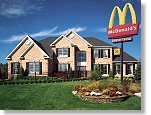
 According to this veddy interesting article in Slate, the size of a CEO’s house may bear an inverse relationship to the performance of the company’s stock on his watch. If this proves to be true over the entire CEO sector, you can expect hysterical investors to drive Zillow to the top of the web, and Architectural Digest to become a hollow shell of its former self.
And George W. Bush to propose real estate offsets, wherein CEOs in monster McMansions get tax breaks for paying destitute Third Worlders to live eighteen to a room.
In a working paper titled “Where are the Shareholders’ Mansions?” David Yermack of New York University and Crocker Liu of Arizona State wonder whether there is a relationship between CEO home-buying behavior and stock performance. (The title is a riff on the classic 1940 investment book Where Are the Customers’ Yachts?.) In doing so, the two academics are invading one of the last preserves of executive privacy, and we should all be very grateful! …
Yermack and Liu insist there’s a solid academic reason to look through the keyholes. They want to figure out if a mansion purchase signals commitment or cashing out. A CEO who buys a 12,000-square-foot mansion could be showing his intent to stay for the long haul and to bust his butt so that he’ll have the cash to pay off the huge mortgage. In which case, you’d expect stocks of the companies where the CEO just bought an obscenely large house to thrive. Buy!
Or the purchase of an absurdly large house could signal entrenchment: The CEO is too comfortable with his position and his personal finances. He has made so much money that he can’t really be bothered with running the company. And the willingness to spend gazillions on a house—not to mention the furnishings, artwork, and baubles to fill it—betokens a general inattentiveness to costs. In which case, you’d expect stocks of the companies where the CEO just bought an obscenely large house to fare poorly. Sell!
Especially if, like me, you know that those CEOs often bought those houses with company-financed and company-guaranteed loans that are contractually obligated to be company-forgiven when the CEO leaves said company for whatever reason including stunning incompetence, mendacity, or criminality.
 ::
::  ::
::  ::
::  ::
::  ::
::  ::
::  ::
::  ::
::  ::
::  ::
:: 
 raincoaster