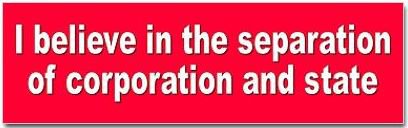
I'm all for the separation of Corp and State. You?
A hundred years ago, anything worth saying had already been said by Oscar Wilde and/or George Bernard Shaw. Today anything worth saying has already been said by George Carlin and/or Fran Lebowitz. We’ve already reviewed what George presciently said about Occupy Wall Street, so now let’s take a trip in the TARDIS back to the July, 1997 issue of Vanity Fair and see what the Sage of Manhattan had to say about Occupy Wall Street and its offspring.
Do you agree with Calvin Coolidge that “the chief business of the American people is business?”
I think that in the current climate Calvin Coolidge might be regarded as almost a Beatnik, since it seems widely accepted that the only business of the American people is business — and that the appropriate model for all human endeavor is the business model. People contstantly say things like “If I ran my business the way they run the public school system, I’d be out of business in three weeks.” People seem to have the idea that these things are similar in some way. If they ran the public school system the way you run your business, people would be even less educated than they are now, because the purpose of business is to earn a profit. This is not the purpose of education. Additionally, it is not hard to imagine down-sizing in this context — grades four through nine being regarded as middle management and hence eliminated. It is equally easy to envision at some imminent point in time that during the State of the Union address, when the camera pans above the head of the president, instead of the great seal of the United States of America we will see the Nike symbol. Direct corporate sponsorship of the federal government.
People accept this sort of thing in every way now. People accept a level of commercialization of every single aspect of life that is shocking to someone of my age. you pay nine dollars to go to the movies and they show you commericals for 20 minutes. Not ony commercials for other movies — which they get you to call trailers or previews, like, “How lucky for you. For your nine dollars we’re throwing in 75 previews” — but also commercials for products like Coca-Cola. When they started showing these — which wasn’t that long ago, although everyone now seems unable to remember a time when this did not occur — people in New York used to boo them, but now they don’t. They expect to pay to see commercials. It takes two seconds, it seems, to get people used to this kind of thing. I, on the other hand, still can’t get used to paying for television. A television bill. It’s astonishing. And even more astonishing is that other people regard this as a technological advance, whereas to me it seems this is technology going backward. I feel that if at first television had been cable TV — this enormous, clunky, cumbersome, labor-intensive, expensive system — and then some genius figured out broadcast television, people would have said, “Can you imagine? They don’t have to dig up the streets anymore. They don’t need the big wires. You can move your tv around. It doesn’t have to be attached to your wall. And it’s free. It goes through the air. It’s a miracle of modern technology — of course, there’ll have to be commercials.
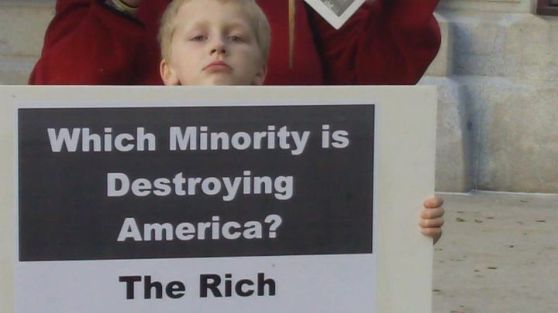
The 99%
 raincoaster