Some things (mostly Parisian things, it must be admitted) are classics.

The Decisive Moment, 1932
Some things are more of their time.

The Decisive Moment, 2009


Some things (mostly Parisian things, it must be admitted) are classics.
The Decisive Moment, 1932
Some things are more of their time.
The Decisive Moment, 2009
Yes, Virginia, fairies do exist.
This is a controversial issue we’ve covered frequently in the past. You will note the comments of the doubters; never supplying a single shred of evidence to support their theory, they deal in third-hand rumours and blatant pig-headedness to support their outrageous hypothesis that fairies are imaginary. It’s a scandal that so-called “rationalists” could indulge in unsubstantiated rumour-mongering of this nature.
Do you think Shakespeare, who wrote about Julius Caesar and the dubious merits of Scottish hosts, would make shit up? Do ya, punk?
Now, from TackyRaccoons, comes clear photographic proof of the existence of these delightful sprites. Polaroids, as everyone knows, cannot be faked.
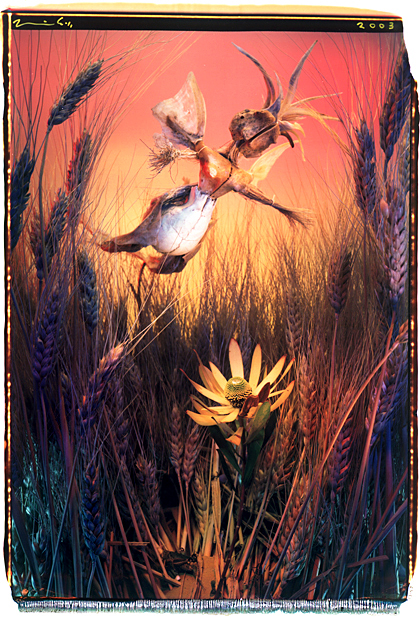
Not only do we now have real proof that they exist, but we are beginning to understand how they reproduce. In this comment I suggested an hypothesis of fairy generation, and not long after that pictoral evidence surfaced to support my theory that they were not gestated in banal fashion like so many mortals, but instead crawled out from between the petals on the undersides of mushrooms. And here is the picture that proves it.

Case? Closed!
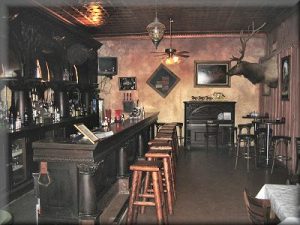
So, the other night I was, as I am not infrequently, at the bar of the Irish Heather, spending, as I do not infrequently, too damn much money for somebody who blogs for a living, and I met, as I not infrequently do, an Irishman.
I mean, where else would you? Right? Amiright?
And his Zimbabwean sidekick, Julius I’m Not Kidding You although he may have been telling a stretcher Caesar. Julius Caesar.
I never did catch the Irishman’s name, either because it was so exotic or because I have a cold and my ears were stuffed up with Strongbow I mean earwax now where was I?
Right. At the bar of the Irish Heather, talking about luck with a lanky, nameless Irishman and a black guy from Zimbabwe called Julius Caesar. They’d just gotten back from the Yukon, where they were checking out the dogsled race and NO I AM NOT MAKING THIS UP the one that goes all the way to Alaska, and thereupon I told them my story about the American Minutemen guarding the border and the time one of them shot himself in the foot and Canada refused to let him in, as he did not have proper identification documents and they must have laughed and laughed at Canadian Border Guard Union Headquarters over that one, oh yes.
And then the Irishman told me the secret of winning bar bets, which he then proceeded to prove by winning two toonies from me. But he bought me a Strongbow, so I figure I came out four bucks ahead when you figure tax into it which in Canada you always do, on general principles and yes, even in bar bets.
And this is the secret:
Get the other person to make a bet, and bet against him.
You’re welcome.
Ah, the French Public Intellectual; surely there is no institution more revered, nor more maligned, than this. Too highbrow for the mob, too refined for a vulgar concept such as progress, the French Intellectual was for all too long stuck in place, immovable, unyielding.
No more.
Now, we present the future of Dada (and, possibly, MOMA too): Remi Gaillard, in his masterpiece, Elevator:
 and I quote:
No weird revelation is involved when someone sees a dime on the sidewalk, picks up the coin, and pockets it. Even if this is not an everyday occurrence for a given individual, it remains without any overtones or implications of the fateful, the extraordinary. But suppose this coin has some unusual feature that, upon investigation, makes it a token of considerable wealth. Suddenly a great change, or at least the potential for change, enters into someone’s life; suddenly the expected course of things threatens to veer off toward wholly unforeseen destinations.
It could seem that the coin might have been overlooked as it lay on the pavement, that its finder might easily have passed it by as others surely had done. But whoever had found this unusual object and discovers its significance soon realizes something: that he has been lured into a trap and is finding it difficult to imagine that things might have been different. The former prospects of life become distant and can now be seen to have been tentative in any case: what did he ever really know about the path his life was on before he came upon that coin? Obviously very little. But what does he know about such things now that they have taken a rather melodramatic turn? No more than he ever did, which becomes even more apparent when he eventually falls victim to a spectral numismatist who wants his rare coin returned. Then our finder-keeper comes into a terrible knowledge about the unknowable, the mysterious, the truly weird aspect of his existence – the extraordinary fact of the universe and of one’s being in it. Paradoxically, it is the uncommon event that may best demonstrate the common predicament.
Thomas Ligotti, in the Foreward to Noctuary

 raincoaster