then vs now

“Then” being back when I had a 9-5 (actually, more like a 5am-9pm) with Starbucks and “Now” being now that I’ve lived here long enough to be accepted as “honorary Chinese” at the shops around these parts.

Then: three kinds of pasta
Now: three kinds of seaweed

Then: Kitsilano restaurants four nights a week
Now: poverty vegetarian stirfry five nights a week

Then: jogging at two in the morning because that’s when I got home
Now: jogging at two in the morning because that’s as late as I can put it off

Then: chinos and “dress shorts” five days a week
Now: pjs and workout clothes 9-5, cocktail dresses 5-12. I think I have chinos…

Then: smelled like coffee
Now: smell like whatever Chanel scent I last bought when I had a windfall, currently Allure

Then: SpaLady gym 3x week, running in the rain
Now: climbing apartment stairwells and doing exercise videos 3x week, running in the rain

Note: never, not for a moment, consider joining a single-sex gym. At the SpaLady there was a large group (in all senses of the word) of Eastern European women, all of whom still believed that undergarments were still strictly rationed in the West. In order to preserve the structural integrity of their bras and cheap nylon granny panties, they wore them OVER their t-shirts and polyester slacks with the topstitched crease. And they did this while wearing curlers in their hair, accented with cheap polyester chiffon headscarves.

Please God I never have to see something like that again: a row of them on the stairmasters in front of me meant I would be switching to the rowing machine ASAP. A row of jiggling granny panties, with or without lace elastic ruffles, is enough to turn anyone bulimic.

Russian positivism

From Popbitch:

RIP Yeltsin. The best quote on his presidency came
from his prime minister, Viktor Chernomyrdin,

“We hoped for the best, but things turned out as usual.”

add to del.icio.us :: Add to Blinkslist :: add to furl :: Digg it :: add to ma.gnolia :: Stumble It! :: add to simpy :: seed the vine :: :: :: TailRank

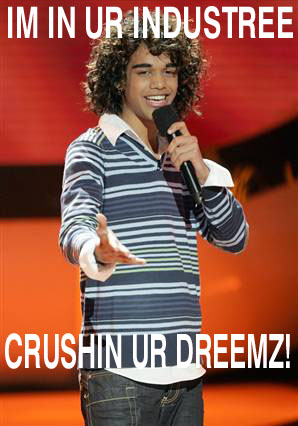
website o’ the day: lolgays!

lolSanjina!

Join me, please, in extending a warm, tentacly, raincoaster embrace to lolgay.com, the newest, bestest site on the whole internets. Sure, you can has cheezeburger, but why would you want to when you know those calories go straight to your ass?

Lolcats = Web 2.0

Lolgays = Web 2.Oh!

wot u staring at?

add to del.icio.us :: Add to Blinkslist :: add to furl :: Digg it :: add to ma.gnolia :: Stumble It! :: add to simpy :: seed the vine :: :: :: TailRank

quiz: what’s your pretentious dissertation title

Passed along by defrostindoors at Bridlepath.

The Pretentious Dissertation Title Mini-Quiz by MagnaMaxima
Username raincoaster
Your Field Philosophy
Your Dissertation’s Pretentious Title California Dreaming:
Your Dissertation’s Pretentious Subtitle The Poetics of Ugliness

add to del.icio.us :: Add to Blinkslist :: add to furl :: Digg it :: add to ma.gnolia :: Stumble It! :: add to simpy :: seed the vine :: :: :: TailRank

David Halberstam’s last speech

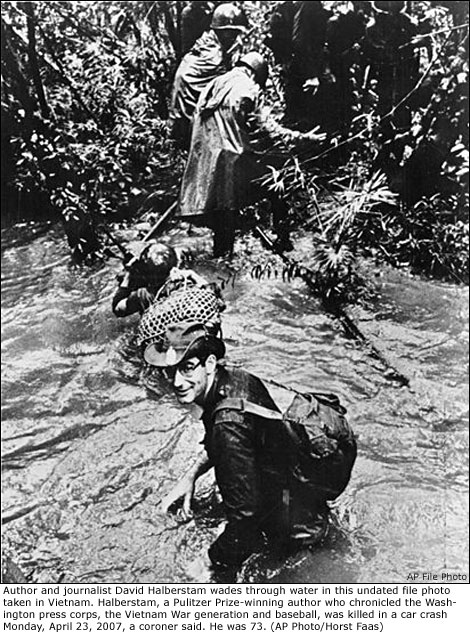
David Halberstam in Vietnam 

From, of all places, Business Week (via Gawker) we present the last speech of David Halberstam, greatest journalist of his generation and one of the immortals in a field which was pioneered by other lightweights like Jonathan Swift and Voltaire. I can’t say it any better than Business Week did, so let’s go to the article:

History, after all, was a favorite theme of this lion of American journalism. In 1955, after graduating from Harvard, Halberstam took a job at The Daily Times Leader in West Point, Miss., because he thought it would provide him an opportunity to write about race. When that didn’t work out as he had planned, Halberstam hitchhiked up to Nashville and put in an application at The Tennessean.

There, he wrote about race with a vengeance. In 1960, The New York Times lured him away. In 1964, when Halberstam was 30, he and Malcolm Browne of the Associated Press won Pulitzers for their coverage of the Vietnam War and the overthrow of the Saigon regime.

In 1967, Halberstam quit daily journalism and began writing books. Over the next 40 years he wrote 21 books covering such topics as foreign policy, civil rights, business, and sports. His 1973 classic about the Vietnam War, The Best and the Brightest, described how and why the “ablest men to serve in the government this century” turned out to be “architects of the greatest American tragedy since the Civil War.”

In 1994, The Reckoning addressed the Japanese challenge to American automakers. And in 2000 The Powers that Be tackled the rise of the American media. Halberstam’s 21st book, The Coldest Winter, a look back at the Korean War, will be released this fall. “I think it’s my best work,” he said in his Apr. 21 speech.

transcript here

add to del.icio.us :: Add to Blinkslist :: add to furl :: Digg it :: add to ma.gnolia :: Stumble It! :: add to simpy :: seed the vine :: :: :: TailRank