TWAT: the war against t-shirts

the war against tees

That’s a fine looking fellow, the guy on the left. And a fine looking shirt he’s got on, too. Can you read it? I can’t, which is why I had to read the article about him and his shirt and why it’s illegal at JFK.

The article that informs me that it is now illegal to wear a shirt with Arabic writing on it in American airports.

Yes, TWAT is now The War Against Tees.

Then I once again asked the three of them : “How come you are asking me to change my t-shirt? Isn’t this my constitutional right to wear it? I am ready to change it if you tell me why I should. Do you have an order against Arabic t-shirts? Is there such a law against Arabic script?”

so inspector Harris answered “you can’t wear a t-shirt with Arabic script and come to an airport. It is like wearing a t-shirt that reads “I am a robber” and going to a bank”.

I said “but the message on my t-shirt is not offensive, it just says “we will not be silent“. I got this t-shirt from Washington DC. There are more than a 1000 t-shirts printed with the same slogan, you can google them or email them at wewillnotbesilent@gmail.com . It is printed in many other languages: Arabic, Farsi, Spanish, English, etc.”

Inspector Harris said: “We cant make sure that your t-shirt means we will not be silent, we don’t have a translator. Maybe it means something else”.

I said: “But as you can see, the statement is in both Arabic and English“.

He said “maybe it is not the same message“…

At the point of almost missing his flight, he allows JetBlue to buy him another shirt to wear over the “illegal” one. Apparently, lots of people had called and ratted him out. Remind me to dig out the story of my Arabic necklace and the nice lady at US Customs and Immigration.

I put the t-shirt on and removed the price tag. I told the four people who were involved in the conversation: “I feel very sad that my personal freedom was taken away like this. I grew up under authoritarian governments in the Middle East, and one of the reasons I chose to move to the US was that I don’t want an officer to make me change my t-shirt. I will pursue this incident today through a Constitutional rights organization, and I am sure we will meet soon”.

If you want to call Jet Blue and ask about their regulations against Arabic script, you can use the following numbers:
* If calling within the U.S., Bahamas or Puerto Rico: 1-800-JETBLUE (538-2583)
* If calling from the Dominican Republic: 1-200-9898
* If calling from outside the U.S. or Dominican Republic: 001-801-365-2525
* Customers who are deaf or heard of hearing (TTY/TDD): 1-800-336-553

Raed Jarrar’s blog Raed in the middle

Survivor: South Park Tribes

South Park Tribes

From Defamer, cuz you just knew they were gonna be all over this story.

So it seems that the Australian genius behind Survivor isn’t completely immune to stereotypically uh…Australian behavior. He and his flying monkeys at the prodco have decided that what Survivor really needs is blatant racial conflict, and who among us can say they’re wrong?

I’m of the opinion that what it needs is a swift dose of euthanasia, but that’s just me…

Yes, this year for Survivor: Cook Island, they’re dividing the teams up by race. Simple, efficient, and already worth about 30,000 words of press.

The Defamer commentors have all the best lines in this case, not to mention the best illustration, which I stole and posted above.

BoHan says:

Scientology vs. Kaballah. That would rock. Plus you wouldn’t have to search to hard to find the token gay person. I’ve heard of one Scientologist today whose dance card is now wide open.

and the immortal:

Toothy_Tile says:

Welcome to CBS’ “Fun with outdated stereotypes and gross generalizations!” This will be a difficult one to handicap. With no cars to drive on the island, Team Asian‘s traditional achilles heel will be out of the picture. Team Latino will be pretty good at gathering the fruits and vegetables, no doubt. Team African-American will of course sweep the athletic challenges.

Team Whitey can go a few different ways, of course. If the team is mostly Jewish, it’ll waste its time starting conflicts and lending conch-shells-as-currency to the other teams, which will distract it from the challenges at hand. If the team is mostly Italian-American, expect the other teams to suffer random kneecap injuries, and lots of impromptu ways of cooking maggots and cockroaches in marinara sauce. And if the team is WASPy, expect it to get ahead by hacking into the other teams’ Sidekicks, spewing racial epithets all around, opening an outdoor nightclub or boutique hotel on the Westside of Cook Island, and gaining extra boosts of energy by doing lines of coke off of stray coconut husks.

reasons not to invade Iraq: George Herbert Walker Bush

From the Memory Hole:

“Why We Didn’t Remove Saddam”

George Bush [Sr.] and Brent Scowcroft
Time (2 March 1998)

The end of effective Iraqi resistance came with a rapidity which surprised us all, and we were perhaps psychologically unprepared for the sudden transition from fighting to peacemaking. True to the guidelines we had established, when we had achieved our strategic objectives (ejecting Iraqi forces from Kuwait and eroding Saddam’s threat to the region) we stopped the fighting. But the necessary limitations placed on our objectives, the fog of war, and the lack of “battleship Missouri” surrender unfortunately left unresolved problems, and new ones arose.

We were disappointed that Saddam’s defeat did not break his hold on power, as many of our Arab allies had predicted and we had come to expect. President Bush repeatedly declared that the fate of Saddam Hussein was up to the Iraqi people. Occasionally, he indicated that removal of Saddam would be welcome, but for very practical reasons there was never a promise to aid an uprising. While we hoped that popular revolt or coup would topple Saddam, neither the U.S. nor the countries of the region wished to see the breakup of the Iraqi state. We were concerned about the long-term balance of power at the head of the Gulf. Trying to eliminate Saddam, extending the ground war into an occupation of Iraq, would have violated our guideline about not changing objectives in midstream, engaging in “mission creep,” and would have incurred incalculable human and political costs. Apprehending him was probably impossible. We had been unable to find Noriega in Panama, which we knew intimately. We would have been forced to occupy Baghdad and, in effect, rule Iraq. The coalition would instantly have collapsed, the Arabs deserting it in anger and other allies pulling out as well. Under those circumstances, furthermore, we had been self-consciously trying to set a pattern for handling aggression in the post-cold war world. Going in and occupying Iraq, thus unilaterally exceeding the U.N.’s mandate, would have destroyed the precedent of international response to aggression we hoped to establish. Had we gone the invasion route, the U.S. could conceivably still be an occupying power in a bitterly hostile land. It would have been a dramatically different–and perhaps barren–outcome.

We discussed at length forcing Saddam himself to accept the terms of Iraqi defeat at Safwan–just north of the Kuwait-Iraq border–and thus the responsibility and political consequences for the humiliation of such a devastating defeat. In the end, we asked ourselves what we would do if he refused. We concluded that we would be left with two options: continue the conflict until he backed down, or retreat from our demands. The latter would have sent a disastrous signal. The former would have split our Arab colleagues from the coalition and, de facto, forced us to change our objectives. Given those unpalatable choices, we allowed Saddam to avoid personal surrender and permitted him to send one of his generals. Perhaps we could have devised a system of selected punishment, such as air strikes on different military units, which would have proved a viable third option, but we had fulfilled our well-defined mission; Safwan was waiting.

As the conflict wound down, we felt a sense of urgency on the part of the coalition Arabs to get it over with and return to normal. This meant quickly withdrawing U.S. forces to an absolute minimum. Earlier there had been some concern in Arab ranks that once they allowed U.S. forces into the Middle East, we would be there to stay. Saddam’s propaganda machine fanned these worries. Our prompt withdrawal helped cement our position with our Arab allies, who now trusted us far more than they ever had. We had come to their assistance in their time of need, asked nothing for ourselves, and left again when the job was done. Despite some criticism of our conduct of the war, the Israelis too had their faith in us solidified. We had shown our ability–and willingness–to intervene in the Middle East in a decisive way when our interests were challenged. We had also crippled the military capability of one of their most bitter enemies in the region. Our new credibility (coupled with Yasser Arafat’s need to redeem his image after backing the wrong side in the war) had a quick and substantial payoff in the form of a Middle East peace conference in Madrid.

The Gulf War had far greater significance to the emerging post-cold war world than simply reversing Iraqi aggression and restoring Kuwait. Its magnitude and significance impelled us from the outset to extend our strategic vision beyond the crisis to the kind of precedent we should lay down for the future. From an American foreign-policymaking perspective, we sought to respond in a manner which would win broad domestic support and which could be applied universally to other crises. In international terms, we tried to establish a model for the use of force. First and foremost was the principle that aggression cannot pay. If we dealt properly with Iraq, that should go a long way toward dissuading future would-be aggressors. We also believed that the U.S. should not go it alone, that a multilateral approach was better. This was, in part, a practical matter. Mounting an effective military counter to Iraq’s invasion required the backing and bases of Saudi Arabia and other Arab states.

multiculturalism in action: stealing Japadog post!

I’m simply stealing this from Raj, cuz he stole the idea from me. Thus, the Internet comes full circle; no longer a series of tubes, it’s become a series of hula hoops. And I’m not apologizing for the hotlinking, either. At least not till he’s bought me one.

Famous Japadog

Japanese hotdog? Sound appealing? Well it is! On Lorraine’s reccomendation, I took a chance at the hotdog stand on the corner of Smithe and Burrard, close to the Sutton Place Hotel.

So what’s in a Japadog anyways? There’s two varieties that this particular stand sells.

The Terimayo which hosts Teriyaki Sauce, Mayo, Japanese Seaweed and Fried Onions on a 100% beef hot dog.

The Oroshi is composed of special Soy Sauce, Oroshi Daikon Radish, Green Onions on a Bratwurst (white pork) sausage.

I tried the Oroshi on my last visit and look forward to trying the Terimayo next time. Delicious! The Daikon made the bun a bit soggy towards the end tho but upon comment to the ‘chef’ she said that she’ll endeavour to squeeze the radish out a bit better next time. Photos posted below.

line o’ the day: BoingBoing on TWAT

from guess where:

The terrorists hate our freedom, so by eliminating the freedom, we can stop the terrorists from hating us.

The whole post:

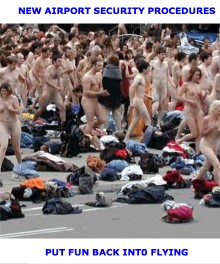
RyanAir, the discount airline that’s threatened to RyanAir nekkids!sue the UK government over new security procedures has posted this provocative image to its website: a crowd of naked people running away from their piled-up clothes, with the caption “New Airport Security Procedures Put the Fun Back Into Flying.”

They’re onto something here. If the existence of a plot to use implausible liquid explosives against aircraft creates a global war on moisture at the airports, imagine what a similar plot to smuggle a bomb up a terrorist’s ass would engender. The war on moisture is bad, but it’s nothing compared to the inevitable war on body cavities.

The terrorists hate our freedom, so by eliminating the freedom, we can stop the terrorists from hating us. Link (Thanks, Michael!)

Update: Eileen sez, ” Looks like the outtake from a Spencer Tunick photo shoot.”

Sure, this is a publicity stunt by RyanAir, but I can think of worse targets. If safety were really an issue, I’d be the last person to have a problem with this. I’m always the one rolling my eyes at the brain-dead whiners who complain about de-icing. But the ridiculous TWAT measures are nothing more than a sophisticated way in training us to take crap from people in uniform, believing all the while that it’s for our own protection.

It’s not. It’s for theirs.