Killer Croc!

You may notice a theme here at the ol’ raincoaster blog; an aquatic, perhaps even amphibious theme: water monsters. And in the pantheon of water monsters, Gustave the Killer Croc ranks very high indeed.

Gustave is just your average Burundian crocodile. He minds his own business, he keeps to himself, he weighs over a ton, he’s the length of a schoolbus, he kills and eats a few fishermen from time to time (estimates range up to 300, although this may be subject to the “African Hyperbole Discount“). There is some hesitation to take issue with his murderous ways, however, because he is indeed quite large and, apparently, impervious to bullets. He even has a colourful French nemesis, just like in the comic books: Patrice Faye, an obsessed Gustave-hunter:

Like Captain Ahab, the self-taught naturalist is preoccupied with one monster in particular: Gustave, the largest, most fabled crocodile in all of Africa—a demonic Loch Ness Monster of incredible proportions and, according to legend, appetite. Gustave is reputed to have devoured hundreds of villagers, snatching them from the banks of the Rusizi and the northeastern shores of Lake Tanganyika. Faye estimates that the massive croc measures 20 feet (6 meters) long, weighs one ton (907 kilograms), and is 60 years old (wild crocs, on average, live to age 45). Trained herpetologists agree that Gustave could be that large and that he is certainly one of the most infamous man-eaters of all time. But Faye’s assertion that Gustave kills for sport—knocking off villager after villager like some killing machine—leaves skeptics clearing their throats.

Well, personally I don’t think reptiles are that bright, but then I don’t think country-western fans are smart enough to walk on their hind legs unassisted either, yet somehow they do! Gustave went underground for a period, but has been seen as recently as February of this year, identified by the numerous and completely ineffectual bulletholes that pocket his scaly hide.

But enough talk, let’s take a look at this beaut:

when chickens go bad

Rumsfeld and a chickenLongtime fans of the ol’ raincoaster blog will recall the somewhat…epic consequences of a bad oyster. There is, presumably, no need for us to go there again, even from the comforting distance of the far end of a laparoscope. Given the devastating effect that only a small invertebrate can have, a simple act of extrapolation is all that is necessary to comprehend the potential tsunami of destruction that could result, were this principle to be extended to larger, more complex creatures.

Ladies and gentlemen, I am sorry to inform you that the nightmare is real. The nightmare, my friends, has landed.

In Connecticut.

Authorities in Connecticut are wondering who stuffed a raw roasting chicken with a pipe bomb and left it on a roadside…the Hartford Police Department’s bomb squad came and blew up the chicken.

Chickens, gentle readers, are not born suicide bombers. No indeed; most chickens have not a thought in their heads beyond scratching out a living, or passing the time of day with one another by speculating about the possible effect of gravity on the celestial dome. It is perhaps this philosophical streak which brought the bird above to her ultimate doom; she had no recorded links with either radical Islam or the IRA.

In contrast, some birds give their whole lives selflessly to ensure that human beings the world over do not go hungry. Once they’ve met the stringent criteria for joining the Colonel‘s army, these big-breasted chicks travel the world, serving populations as disparate as those of the Upper East Side and downtown Davao. But, while most famous of poultry devoted to humanity’s welfare, they are not alone.

In news the world has been waiting for since the dawn of medical science, it has just been announced that Peking Duck cures cancer and heart disease!

An extract of red yeast rice, which gives Peking duck its distinctive colour, may cut cancer deaths by two-thirds and heart disease by a third.Red yeast rice has been used in China for thousands of years as a preservative and as a herbal medicine for 1,000 years…
It is the colouring ingredient used widely in Chinese food and is found in pickled tofu, Peking duck and some types of red-coloured Japanese sake. The rice is fermented by adding a red yeast, monascus purpureus, with alcohol before removing the rice gluten.
Used medicinally, it has been known to improve blood circulation and aid digestion.
Sake too? Sake to me!

Ten-Tentacle Treats!

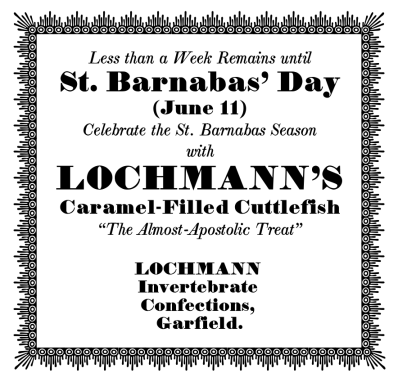
Ah, who doesn’t love finger foods? With my birthday just a wee tad over one slim month away, I’ve been looking around for suitable refreshments for my Friki Tiki birthday party (goth/tiki, you’re all invited! Bring booze!) And here we have just the thing: first up, Lochmann’s caramel-filled cuttlefish from Dr Boli‘s smorgasbord of demented delights:

Lochmann\'s Caramel Cuttlefish

If that doesn’t satisfy your craving for cephalopods and/or creepy-crawlies (is hyphenated, yes? no? but yes?), try a few of these, from the kitschy kitchen of Tacky Raccoons:

Squid Sickles, all the rage in Rlyeh

Scorpion Sickles are a bit sharp

Bone A Pet Tit!

When Seafood Goes Bad

This is a subject with which I have an intimate degree of familiarity, so I do not hesitate to post this explosive photo here. I can has immodium?

kitten

Paging Gérard de Nerval!

As we at the ol’ raincoaster blog understand it, Spring is late in coming to parts of the world, and in such times our thoughts go always to those more primitive, dependent species: cephalopods, crustaceans, and government contractors.

Alas, we do not know, for it is not recorded, what became of the famed lobster of Gérard de Nerval, but we would not be at all surprised to discover it still lumbering mournfully around Paris, seeking its owner and the subtle secrets that only dreams can tell

But what if it’s chilly? Does this living national treasure of Symboilist Symbolist Poetry shivver in the chill miasma rising off the Seine? I shudder to think it.

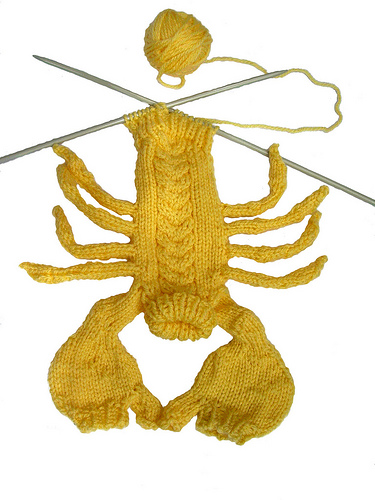
Behold, the solution:

Lobster Sweater