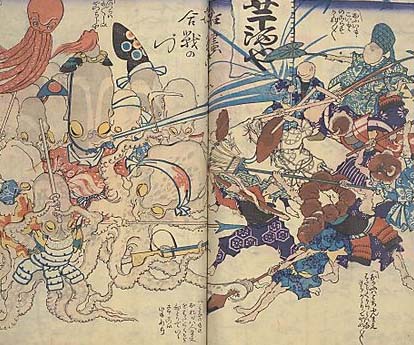
You won’t have heard about this in school, unless, that is, you went to school in Y’ha-nthlei like some of us. The War of the Roses, the Thirty Year’s War, the Boer War…Boering!
The Great Octopus/Potato War is far from over, although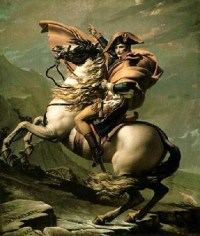 its origins lie in the mist-shrouded vales of distant history. The blog No Sword has unravelled the tangled accounts and written the definitive (so far!) history of these great and bloody battles. It is the opinion of this blogger, as well as the entire staff of Miskatonic University, that great historic events should be understood and explained in terms of art history much more often than they typically are. We can but hope to enrich our knowledge of the Battle of Marengo by analyzing the conformation of Napoleon‘s famous steed in the great portrait, and to reach a level of understanding of the American Revolution through a paintstroke analysis of Washington Crossing the Delaware.
Let us begin by examining the famous picture more closely. [ed note: yes, by all means let us begin thusly!] The octopus soldiers display a confidence that borders on arrogance. One claims to be able to do the work of eight men — clearly a hubristic miscalculation, unless he believes that humans and by extension potatoes can only use one arm at a time.
Nevertheless, the octopus troop is clearly unwilling to go on the offensive. They taunt and spit, but do not attack. This insulting treatment can only have be an attempt to provoke the potato soldiers into an ill-advised attack on the octopus position, and it seems to have worked precisely as intended…
Earlier in 1868 alone, they had already taken heavy losses in the brutal East-West Fart-Off (東西屁ひりくらへ — left, right) even as they provided logistical support for another, unrelated Fart Battle (屁合戦兵粮 — left, right) elsewhere…
This gem of military art history appreciation (truly, it’s as if Toynbee himself had fathered a love child with Sister Wendy!) comes our way via Japanprobe.
 ::
::  ::
::  ::
::  ::
::  ::
::  ::
::  ::
::  ::
::  ::
::  ::
:: 
Don't keep it to yourself!

 raincoaster