Artist Chris Jordan makes digital images depicting just what and how much Americans use and discard every day. This, for instance, is an image of the two million plastic bottles that the US uses and throws away every five minutes.
He’s also done an image of 65,000 cigarettes, one for every teenager who becomes addicted to smoking per month; an image of jet contrails; plastic and paper bags thrown out, and many others. This puts our own actions in context in a very powerful way: it’s not just me, it’s us, and this is what we do and this is the debris we leave behind.
But you have to wonder if it hadn’t, or, if it had, who it was who got to make that call.
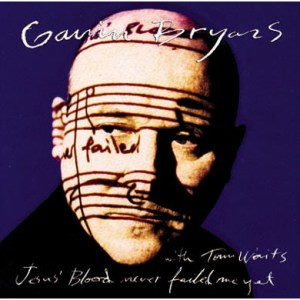
This song has haunted not my dreams but my waking for nearly ten years, ever since Mister Natural played it for me.
The story is this:
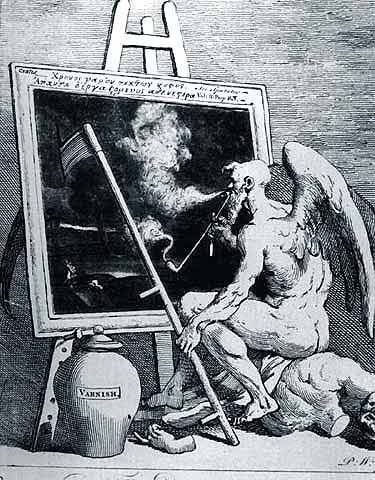
Gavin Bryars, an interesting fellow if ever there was one, was working on a film about the homeless people who populated the neighborhoods of Elephant & Castle and Waterloo Station, a very Hogarthian scene even if gin is not as cheap as it used to be. Not being used to starring in films, the populace enjoyed the attention and in some cases hammed it up for the cameras with appropriate ruffles and flourishes and not a few belts of song or even something stronger.
One of those singers, a teetotaller in fact, came out with this.
I’ve heard it in both the unadorned and orchestral versions, and I must say I prefer the starker one. Adding Tom Waits to the mix is gilding the lily: surely Tom Waits is nothing but an haut-Boho imitation of something the old man was a true original of.
With nothing but this creaky old voice rattling out a single-line message of faith and hope for twenty solid minutes, one can’t help but meditate on it.
This man’s whole life is there, in the tension between his circumstances and his message. He, at least, believes he has never been failed by Jesus (and who are we to say he HAS?) and yet there he is; why, he wouldn’t have been recorded at all if he had not been the very embodiment of society’s lowest castoffs. And so, his cruel circumstances are themselves what enable his inspiring voice to be heard in the first place, yet his moving faith seems so wildly unjustified.
Somewhere between the impossibility of the truth and the impossibility of anything else lies the human condition.
When I copied the loop onto the continuous reel in Leicester, I left the door of the recording studio open (it opened onto one of the large painting studios) while I went downstairs to get a cup of coffee. When I came back I found the normally lively room unnaturally subdued. People were moving about much more slowly than usual, and a few were sitting alone, quietly weeping. I was puzzled until I realized that the tape was still playing and that they had been overcome by the old man’s unaccompanied singing.
This demonstrated to me the emotional power of the music, but also alerted me to the need to approach very carefully anything I did to the tape. I had already thought about a gradually added orchestral accompaniment and I realized that this needed to be simple, to gradually evolve, yet at the same time respect the tramp’s humanity and simple faith.
One again, we step through the looking glass, fall down the rabbit hole, cross the doorway to forever, tune in, turn on, and drop out and end up, somehow, in the crazy, mixed-up world of Brian Atene. In this episode…our hero underplays old skool it in a true tour de force of subtlety. Is it just me, or does Pacino crib off this guy?
Raincoaster,
You’re out five bucks. Its simple puppetry. The head is a disgarded Bill Baird marionette from the ill fated Broadway run of “Baker Street”. You can see the strings clearly on the fade-in of the Kubrick video. I purchased the head in 1980. It’s modeled after actor Martin Gabel. – Atene

 ::
::  ::
::  ::
::  ::
::  ::
::  ::
::  ::
::  ::
::  ::
::  ::
:: 

 raincoaster