
Better known for building igloos during hunts on the polar ice, Inuit in the village of Kuujjuaq in Quebec, Canada, are installing 10 air conditioners for about 25 office workers.
From Reuters, via Fark, and guaranteed 100% photoshop-free.
Better known for building igloos during hunts on the polar ice, Inuit in the village of Kuujjuaq in Quebec, Canada, are installing 10 air conditioners for about 25 office workers.
From Reuters, via Fark, and guaranteed 100% photoshop-free.
Yet another image censored by Photobucket. Just scroll below it to see the image, from a University plaza.

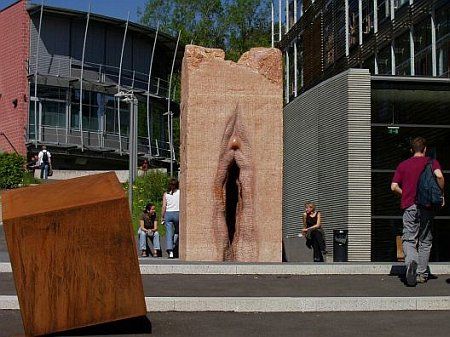
Check that woman’s expression; you’d swear that thing just dropped out of space. Hmmmm, come to think of it, what exactly is she sitting on?
From Hogwild‘s photoroundup of crazy statues, via Fark.
Or so they claim. No Euripedes? No Ovid? The Guardian editors have much to answer for. For much the Guardian editors have to answer.
Whatever.

Here‘s the list, each one with a handy-dandy link to buying it on Amazon, even the ones that have been online at Gutenberg for years.
The case for the defence. Don’t like the list? Post your own suggestions for the 100 best books on the Observer blog.
1. Don Quixote Miguel De Cervantes
The story of the gentle knight and his servant Sancho Panza has entranced readers for centuries.
2. Pilgrim’s Progress John Bunyan
The one with the Slough of Despond and Vanity Fair.
3. Robinson Crusoe Daniel Defoe
The first English novel.
4. Gulliver’s Travels Jonathan Swift
A wonderful satire that still works for all ages, despite the savagery of Swift’s vision.
5. Tom Jones Henry Fielding
The adventures of a high-spirited orphan boy: an unbeatable plot and a lot of sex ending in a blissful marriage.
6. Clarissa Samuel Richardson
One of the longest novels in the English language, but unputdownable.
7. Tristram Shandy Laurence Sterne
One of the first bestsellers, dismissed by Dr Johnson as too fashionable for its own good.
8. Dangerous Liaisons Pierre Choderlos De Laclos
An epistolary novel and a handbook for seducers: foppish, French, and ferocious.
9. Emma Jane Austen
Near impossible choice between this and Pride and Prejudice. But Emma never fails to fascinate and annoy.
10. Frankenstein Mary Shelley
Inspired by spending too much time with Shelley and Byron.
Buy Frankenstein at Amazon.co.uk
…
Who did we miss?
So, are you congratulating yourself on having read everything on our list or screwing the newspaper up into a ball and aiming it at the nearest bin?
Are you wondering what happened to all those American writers from Bret Easton Ellis to Jeffrey Eugenides, from Jonathan Franzen to Cormac McCarthy?
Have women been short-changed? Should we have included Pat Barker, Elizabeth Bowen, A.S. Byatt, Penelope Fitzgerald, Doris Lessing and Iris Murdoch?
What’s happened to novels in translation such as Bulgakov’s The Master and Margarita, Hesse’s Siddhartha, Mishima’s The Sea of Fertility, Süskind’s Perfume and Zola’s Germinal?
Writers such as J.G. Ballard, Julian Barnes, Anthony Burgess, Bruce Chatwin, Robertson Davies, John Fowles, Nick Hornby, Russell Hoban, Somerset Maugham and V.S. Pritchett narrowly missed the final hundred. Were we wrong to lose them?
Let us know what you think. Post your own suggestions for the 100 best books on the Observer blog.

From Tima, via Cold Desert. In Lebanese war blogger news, Ahmad reports that there have been attempts to hack into his blog account; it’s quite obvious that, since the enemies of truth can’t win with logic or facts, they’ve resorted to crime.
 From John McCarthy in the Independent, which I really should read more often. Why in god’s name the home page is made to look as trashy as it is, is a mystery. If it didn’t look so US Weekly, I might actually read the damn thing.
I was pointed to the article over on the BoJo flamewar by Wobbly. And you thought they were extinct, didn’t you?
In any case, there is an interesting amount of debate going on in the press, and this is an article I keep coming back to. Well worth reading, if only for the information that Israel kidnapped two Palestinians the day before the kidnapping of Corporal Shalit, the official excuse for the current war.
In Tony Blair‘s speech in Los Angeles last Tuesday, he said he was sickened by what was happening in Lebanon but went on to effectively absolve Israel of responsibility for the devastation there. He urged: “Just for a moment, put yourself in Israel’s place.”
In that one phrase, our Prime Minister summed up everything that is wrong with our policy for the Middle East.
And before you accuse the author of mindless anti-Semitism and knee-jerk pro-Palestinianism, check the bio notes:
John McCarthy was kidnapped in Lebanon in 1986 and held for five years


