Thought I’d swing by the Art Gallery and see what was shaking. Nothing was except for a security guard who is worried that Anonymous means to blow stuff up. I told him he was taking V for Vendetta too literally, so if you’re wearing an Anonymous mask, go up and shake his hand. Say Hi. Rickroll him. Just don’t blow his shit up, okay?The signs say you can’t stake your tents, so that leaves weighting them down with sandbags or bricks. How you’re supposed to get sandbags and bricks past security, I do not know.
There are already two groups camping out; didn’t see any tents but there were sleeping bags and folding chairs. The place is floodlit and the CBC has a van parked on the grass (which surely can’t be LEGAL, can it? Oh, you one percenters and your sense of privilege!). I wonder if anyone’s going to go up the Hotel Vancouver and rain Champagne corks on the protesters below.
Vancouver Art Gallery Fountain and Hotel Vancouver
Vancouver’s a city of renegades: even our rich people are a little off, so I anticipate much randomness tomorrow. Rumour has it that the official Facebook OccupyVancouver is a front run by the police. Rumour has it that all #OccupyVancouver tweets are actually printed out by the VPD and collated for later reference. Rumours will say anything, but it’s kind of irrelevant if you keep this in mind: All the more reason not to pay attention to any of the “official” groups and take from each source only the things which strike you as of value. Not to get all revolutionary on you, but the closer you publicly identify with any one group, the more predictable you become and the easier you are to control. This is, I remind you, NOT what you want.
If you want to know what you’re allowed to do within the law of BC, here is the Civil disobedience guide. Remember, there’s absolutely no point getting arrested for run of the mill asshattery. You want to get arrested for changing the world for the better, if you want to get arrested. Because if nothing else, you gotta explain why you’re late to work on Monday, and “I wanted to be this guy” won’t cut it.
Like I said on Flickr, you’re not allowed to stake your tents, so you’ve gotta weigh them down with sandbags and/or bricks, and yeah, good luck bringing THAT past security. Who the heck thought THAT was a good idea? I suppose for “green reasons” you could reuse fat tourists, but I’m not sure there are enough to go around.
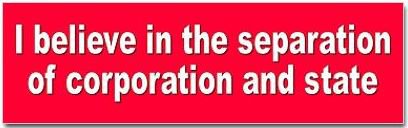
I'm all for the separation of Corp and State. You?
A hundred years ago, anything worth saying had already been said by Oscar Wilde and/or George Bernard Shaw. Today anything worth saying has already been said by George Carlin and/or Fran Lebowitz. We’ve already reviewed what George presciently said about Occupy Wall Street, so now let’s take a trip in the TARDIS back to the July, 1997 issue of Vanity Fair and see what the Sage of Manhattan had to say about Occupy Wall Street and its offspring.
Do you agree with Calvin Coolidge that “the chief business of the American people is business?”
I think that in the current climate Calvin Coolidge might be regarded as almost a Beatnik, since it seems widely accepted that the only business of the American people is business — and that the appropriate model for all human endeavor is the business model. People contstantly say things like “If I ran my business the way they run the public school system, I’d be out of business in three weeks.” People seem to have the idea that these things are similar in some way. If they ran the public school system the way you run your business, people would be even less educated than they are now, because the purpose of business is to earn a profit. This is not the purpose of education. Additionally, it is not hard to imagine down-sizing in this context — grades four through nine being regarded as middle management and hence eliminated. It is equally easy to envision at some imminent point in time that during the State of the Union address, when the camera pans above the head of the president, instead of the great seal of the United States of America we will see the Nike symbol. Direct corporate sponsorship of the federal government.
People accept this sort of thing in every way now. People accept a level of commercialization of every single aspect of life that is shocking to someone of my age. you pay nine dollars to go to the movies and they show you commericals for 20 minutes. Not ony commercials for other movies — which they get you to call trailers or previews, like, “How lucky for you. For your nine dollars we’re throwing in 75 previews” — but also commercials for products like Coca-Cola. When they started showing these — which wasn’t that long ago, although everyone now seems unable to remember a time when this did not occur — people in New York used to boo them, but now they don’t. They expect to pay to see commercials. It takes two seconds, it seems, to get people used to this kind of thing. I, on the other hand, still can’t get used to paying for television. A television bill. It’s astonishing. And even more astonishing is that other people regard this as a technological advance, whereas to me it seems this is technology going backward. I feel that if at first television had been cable TV — this enormous, clunky, cumbersome, labor-intensive, expensive system — and then some genius figured out broadcast television, people would have said, “Can you imagine? They don’t have to dig up the streets anymore. They don’t need the big wires. You can move your tv around. It doesn’t have to be attached to your wall. And it’s free. It goes through the air. It’s a miracle of modern technology — of course, there’ll have to be commercials.
In March, 1792, twenty-four of New York City’s leading merchants met secretly at Corre’s Hotel to discuss ways to bring order to the securities business and to wrest it from their competitors, the auctioneers. Two months later, on May 17, 1792, these merchants signed a document named the Buttonwood Agreement, named after their traditional meeting place, a buttonwood tree. The agreement called for the signers to trade securities only among themselves, to set trading fees, and not to participate in other auctions of securities. These twenty-four men had founded what was to become the New York Stock Exchange. The Exchange would later be located at 11 Wall Street.
Born and bred to exclusivity, raised in full view of the public, and propped up by a taxation system that relies on an affluent bourgeoisie that the system itself seeks to extinguish, it’s no wonder that when the American People exercised their Constitutionally protected freedom of assembly on sidewalks that they’d paid for and built, The System struck back.
Having its servants (I thought they were Public Servants? Silly me) net and then mace a group of peaceful women protestors:
Sooner or later, New York City will run out of cops, or perhaps the budget burden will become so steep that Billionaire Bloomberg will petition the President to bring in Erik Prince and his Band of Bloodthirsty Bros.
Some are already writing the eulogy for #OccupyWallStreet, somewhat prematurely. But all voodoo devotees know you have to write it down before you draw the pentagram and cast the spell to make it come true.
Editors at Adbusters, a Vancouver-based magazine (mission: “topple existing power structures”) wanted to see if they could spark demonstrations just by posting the idea using social media. It created a Twitter topic with the hashtag #OccupyWallStreet, asking people to come to New York’s Financial District to join what they said would be tens of thousands in a “leaderless resistance movement” objecting to banks, capitalism and other perceived evils. Egypt’s Tahrir Square was cited as precedent.
The protests last week were a bust, but perhaps the young protesters learned a lesson: Just because it’s on social media doesn’t make it true.
The article goes on to say that the reports of violence were completely overstated. Scroll up on this post. Or, if you prefer, scroll down.
Yes, Noam Chomsky is a tiresome windbag, but every now and again he’s just…right. Like now (alternate G+ link in case Cusack’s retweet has still crashed the website):
Anyone with eyes open knows that the gangsterism of Wall Street — financial institutions generally — has caused severe damage to the people of the United States (and the world). And should also know that it has been doing so increasingly for over 30 years, as their power in the economy has radically increased, and with it their political power. That has set in motion a vicious cycle that has concentrated immense wealth, and with it political power, in a tiny sector of the population, a fraction of 1%, while the rest increasingly become what is sometimes called “a precariat” — seeking to survive in a precarious existence. They also carry out these ugly activities with almost complete impunity — not only too big to fail, but also “too big to jail.”
The courageous and honorable protests underway in Wall Street should serve to bring this calamity to public attention, and to lead to dedicated efforts to overcome it and set the society on a more healthy course.
For the visual learners among us, here are some instructions from those total slackers and hippies at MIT:
Cheers!
In related news, the Vancouver Philospher’s Cafe this Monday is on whether or not violence is a valid form of expression.
Is violence an appropriate medium of expression?
Our city recently witnessed a display of violence as an expression of disappointment over a lost hockey game. We also have seen societies unleashing collective violence to (presumably) contain further violence. So let’s talk about the morality of violence.
As always, I am hopeful our engagement would reflect the fundamental creed of our Café: any idea worthy of conception, is worthy of reflection, of examination, of analysis, of critique (and of even being laughed at, poked at or mocked provided of course if we can manage to do it respectfully or as deliciously as the late George Carlin would do.)
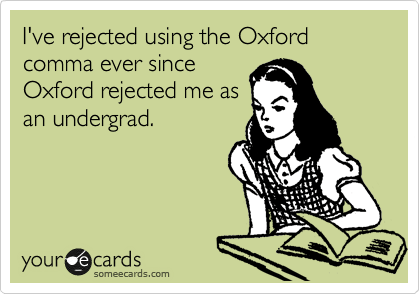
Yes. Yes. Looking over all 4178 posts and an estimated 1,044,500 words here on the ol’ raincoaster blog, it seems we have a strong rival to the Stainless Steel Squid here: the Oxford Comma.
As a general rule, do not use the serial/Oxford comma: so write ‘a, b and c’ not ‘a, b, and c’.
It should be noted that an exception has been made for sentences where an Oxford comma would “assist in the meaning of the sentence or helps to resolve ambiguity,” such as when “one of the items in the list is already joined by ‘and’.”
So, that clears that right up, then. What, Ever. Any fool can SEE I am in love with this thing. SAVE THE OXFORD, COMMA! I’m a sucker for lost causes.





 raincoaster